Currency And Atms In Cebu
Cebu, the island province in the Central Visayas of the Philippines, runs on the Philippine peso, and getting your money right before you land saves both fees and queueing time.
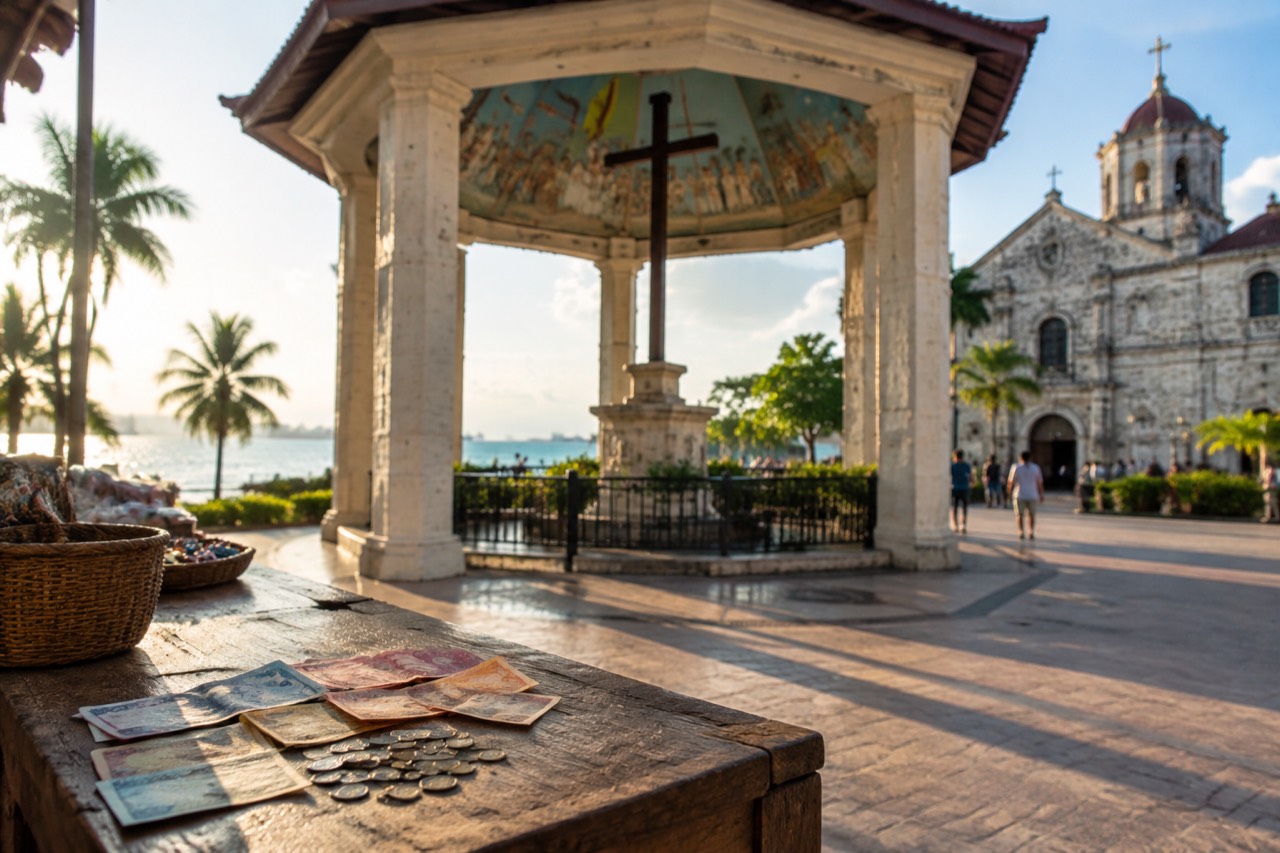
Short answer
Cebu uses the Philippine peso (PHP). ATMs are plentiful in Cebu City and on Mactan but rarer in southern towns like Oslob, so withdraw in the city, expect per-withdrawal fees and limits, and carry cash for entrance fees, jeepneys and small eateries.
Cebu, the island province in the Central Visayas region of the Philippines, runs on one currency and a lot of small change. The Philippine peso (PHP, symbol ₱) is the only legal tender, and while cards are creeping into malls and hotel front desks, huge parts of a Cebu trip still move on cash: jeepney fares, entrance fees at waterfalls, boatmen, habal-habal motorcycle rides and the lechon stall that has never seen a card terminal. This guide covers the peso itself, how ATMs work across the island, what fees to expect, where changing money makes sense, and how to plan a realistic daily budget. It draws on the same figures the rest of Cebu Travel Guide uses, so every peso amount here carries its US dollar equivalent.
What Currency Does Cebu Use?
The whole of Cebu, like the rest of the Philippines, uses the Philippine peso (PHP, ₱), issued by the Bangko Sentral ng Pilipinas, and no other currency is accepted for everyday payment. The practical implication for visitors is simple: you cannot pay in US dollars at a waterfall, a jeepney or a sari-sari store, so everything needs converting. Prices in this guide appear in pesos with US dollar equivalents at the site's pinned exchange rate.
The peso is decimal, 100 centavos to the peso, but centavo coins are functionally extinct in daily life. What matters to a visitor is the note lineup: keep small notes for transport and entrance fees, because drivers and ticket booths routinely struggle to break large denominations. A P1,000 (about US$15.9) note handed over for a jeepney fare will cause a scene.
Banks and money changers will convert your US dollars, euros or other major currencies in Cebu City without difficulty. The Bangko Sentral ng Pilipinas issues the currency, and the New Generation Currency series is what every ATM and teller will hand you. Counterfeiting is rare but not unknown, so give large notes a quick feel when you receive change at informal outlets.
How Do ATMs In Cebu Work For Foreign Cards?
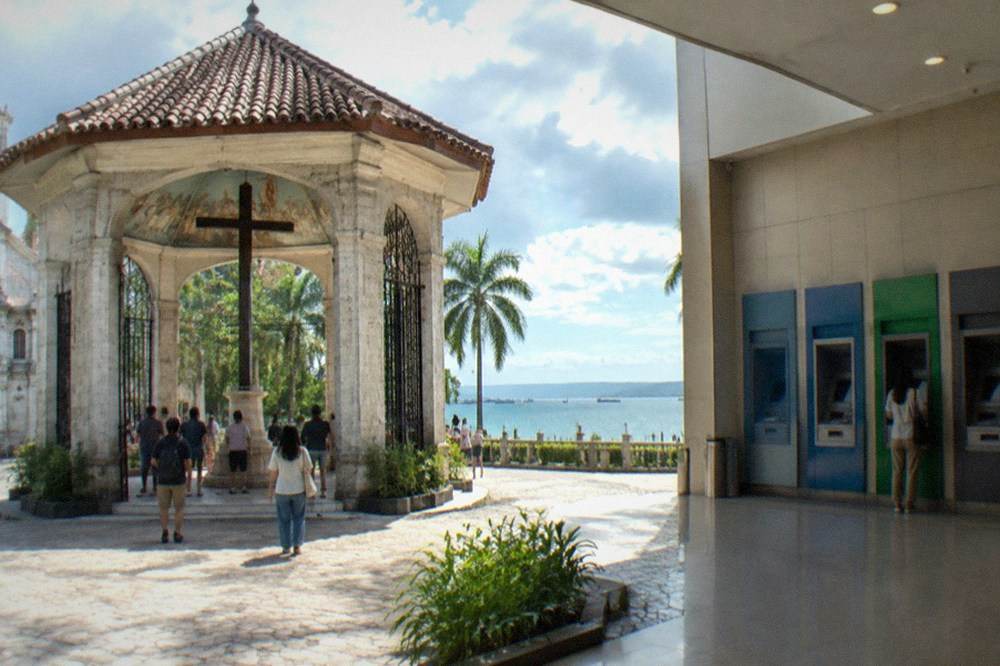
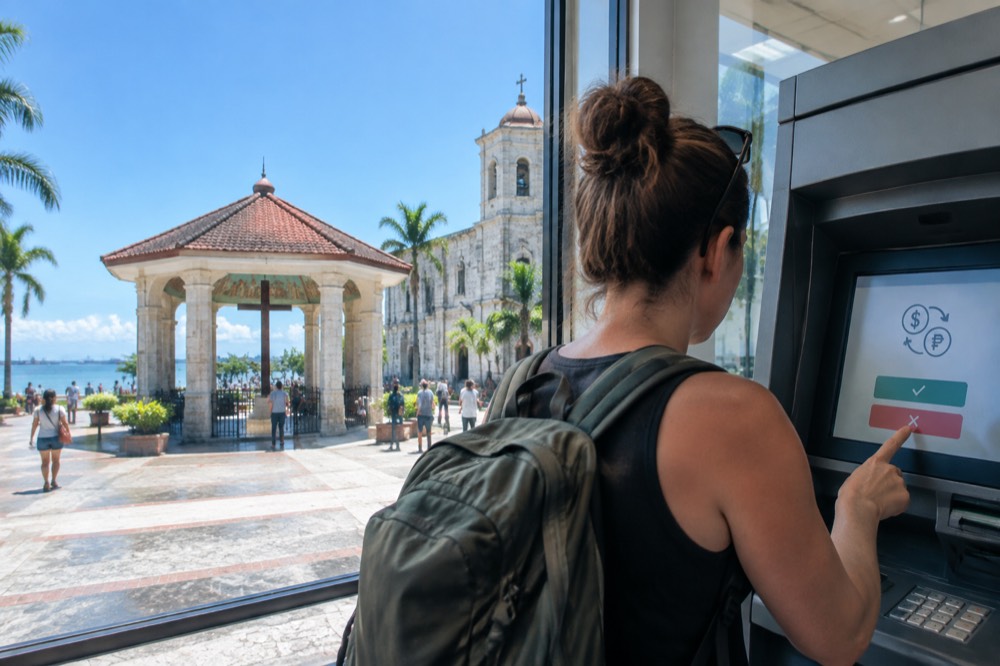
ATMs are dense in Cebu City, Mandaue and Lapu-Lapu on Mactan, inside malls, bank branches and convenience stores, but they thin out fast outside the urban core, and in southern towns such as Oslob and Moalboal a working machine can be a long ride away. Foreign cards are widely accepted at major-bank ATMs, with flat per-withdrawal fees charged by the local bank and again by your home bank, and most machines cap a single withdrawal.
The pattern to internalise is this: withdraw in the city, spend in the countryside. Cebu City and the Mactan side have bank branches clustered around the central business districts, and mall ATMs are the most reliable machines on the island because they are watched, stocked and serviced. Once you head south toward Oslob or west toward Moalboal, ATMs exist but are fewer, sometimes offline, and queues at the few machines can be long on weekends when day-trippers arrive.
Per-withdrawal fees are the real cost. Local banks charge a flat fee per withdrawal to foreign cards, and your own bank adds its own foreign transaction or out-of-network fee on top. Because the fee is flat rather than a percentage, withdrawing the maximum allowed each time, rather than the minimum, is the standard strategy. Check your own bank's fee schedule before travel, since that half of the equation is set at home, not in Cebu.
Two practical warnings from travellers who skip them. First, some ATMs ask, in slightly confusing English, whether you want to be charged in your home currency; always decline and choose to be billed in pesos, because accepting the machine's conversion rate adds a markup on top of everything else. Second, machines sometimes swallow cards or fail mid-transaction during brownouts; if an ATM behaves oddly, cancel and use one inside a bank branch where staff can help.
If you are heading out on one of the island's big day trips, book it while you still have city connectivity and cash discipline on your side. These are the trips that visitors to Cebu typically end up taking:
Where Can You Change Money In Cebu?
Money changers cluster in Cebu City's downtown and mall areas, and mall-based changers and bank foreign-exchange counters generally give better rates than airport counters or hotel front desks, which sit at the bottom of the rate hierarchy. US dollars are the easiest currency to exchange by far, and clean, untorn large-denomination notes get better treatment than worn or marked bills, which some changers refuse outright.
The rate hierarchy is worth stating plainly. Airport counters charge for convenience, hotel desks charge more, mall changers sit near bank rates, and bank counters themselves are competitive but slower, with paperwork and queues. The spread between the best and worst rate on the same transaction can be several hundred pesos, which is a full day's mid-range food budget, so it is worth walking into a mall changer rather than exchanging at arrivals.
Condition genuinely matters. Philippine banks and changers are strict about note quality: folded, torn, taped or heavily marked foreign notes can be rejected or offered a worse rate. Bring crisp notes from home, in larger denominations, and exchange them in the city rather than dribbling them through airport counters.
How Much Cash Should You Carry In Cebu?
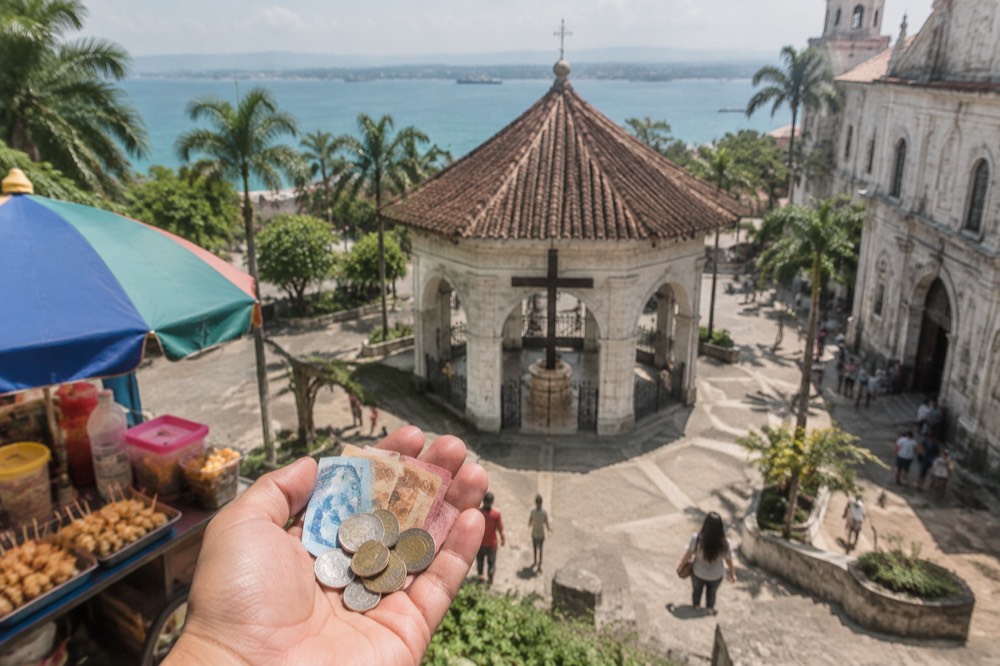
Carry enough cash for a full day of fees, fares, food and small purchases, roughly a few thousand pesos per person in the provinces, because entrance fees, boat rides, habal-habal motorcycle transport and small eateries are all cash-only, and card acceptance collapses fast outside malls and hotels. The verified entrance fees alone add up quickly, so a south Cebu day can consume several thousand pesos before lunch is over.
The reason cash planning matters more in Cebu than in, say, Seoul or Taipei is that the best experiences are cash-only by nature. The verified fee schedule makes the point better than any generalisation:
| Cash expense in Cebu | Verified amount | Notes |
|---|---|---|
| Oslob whale shark watching (foreign visitor) | P1,000 (about US$15.9) | Boat and guide included, set by the Oslob municipal ordinance |
| Oslob whale shark watching (Filipino) | P500 (about US$8.0) | Local rate reverted to in March 2025 |
| Tumalog Falls entrance | P50 (about US$0.8) | Habal-habal from Tan-awan adds P50 (about US$0.8) to P100 (about US$1.6) each way |
| Kawasan Falls Level 1 entrance | P200 (about US$3.2) | Swimming only; canyoneering costs extra and is guide-only |
| Moalboal environmental user fee | P100 (about US$1.6) | Covers swimming and snorkelling at Panagsama |
| Fort San Pedro, Cebu City | P50 (about US$0.8) | Students and seniors pay P40 (about US$0.6) |
| Tops Lookout entry | P100 (about US$1.6) | Seniors and PWD P70 (about US$1.1); open 24 hours |
| Jeepney minimum fare (traditional) | P14 (about US$0.2) | First 4 km, then P2 (about US$0.0) per km |
There is a second dimension to these figures that most first-time visitors miss: Cebu operates a two-tier fee system at many attractions, with a foreigner rate and a lower Filipino rate, and the gap is set by local ordinance rather than by any tour operator. Knowing the dual structure in advance stops the surprise at the kiosk and helps you budget honestly:
| Attraction or fee | Foreign visitor | Filipino / discounted |
|---|---|---|
| Oslob whale shark watching | P1,000 (about US$15.9) | P500 (about US$8.0) |
| Olango Island Wildlife Sanctuary entrance | P100 (about US$1.6) | P30 (about US$0.5) adult |
| Lapu-Lapu island hopping environmental fee | P100 (about US$1.6) | P20 (about US$0.3) (cut from P100 (about US$1.6) in July 2025) |
| Fort San Pedro | P50 (about US$0.8) regular | P40 (about US$0.6) students and seniors |
| Tops Lookout | P100 (about US$1.6) regular | P70 (about US$1.1) senior/PWD |
| Museo Sugbo | P50 (about US$0.8) general | P25 (about US$0.4) students, seniors, PWD |
| Sirao Flower Garden | P100 (about US$1.6) | P80 (about US$1.3) seniors and PWD |
Add meals, and the picture completes. A lechon lunch at a carb-heavy Cebuano institution, a halo-halo stop and a couple of soft drinks will not break a mid-range budget, but none of those stalls takes a card. The site's full budget breakdown lives in the Cebu budget and costs guide, which pairs this page's fee tables with accommodation and food ranges.
Do Credit Cards Work In Cebu?
Credit and debit cards work reliably in Cebu's malls, hotels, resort restaurants and larger tour operators, especially in Cebu City, IT Park and the Mactan resort belt, but they are useless for jeepneys, most taxis booked on the street, island-hopping boatmen, entrance kiosks and the vast majority of local eateries. Visa and Mastercard are the accepted networks almost everywhere cards are taken, and contactless payment is common in the cities but absent in the provinces.
The split is clean and predictable. Anything with a cash register and a roof takes cards; anything with a wooden kiosk and a laminated price list does not. A practical division for a week: put hotel nights, mall shopping and sit-down dinners on the card, and run a separate cash float for everything under a few hundred pesos. More of these guides are collected on Cebu Travel Guide.
One caution that belongs in any honest money guide: card skimming exists in the Philippines as it does anywhere, so prefer ATMs inside bank lobbies or busy mall corridors over standalone street machines, and check restaurant terminals briefly before handing your card over. The site's Cebu safety guide covers the broader picture, including the fact that foreign governments issue no Cebu-specific travel warning beyond the standard nationwide caution level.
What Are The Fees And Traps To Avoid With Money In Cebu?
The four costs that quietly drain a Cebu travel budget are flat foreign-card ATM fees charged per withdrawal, dynamic currency conversion when a machine offers to bill you in your home currency, airport and hotel exchange rates that sit well below mall changer rates, and repeated small withdrawals forced by per-transaction limits, which multiplies the flat fee each time. Avoiding all four is mostly a matter of withdrawing the maximum in the city and declining home-currency billing.
Each trap deserves a sentence. The flat ATM fee means three small withdrawals can cost three times what one large one does, so always take the machine's maximum. Dynamic currency conversion, the "would you like to be charged in your currency?" prompt, adds a markup that can exceed several percent; the answer is always no. Airport changers are for emergencies, not strategy. And the last trap is planning: people who arrive without pesos and head straight to Oslob at 3 AM discover that the whale shark briefing kiosk wants cash, not a card.
The fee landscape also shifts at the edges of the trip. The airport's passenger service charge is bundled into your airline ticket, so there is nothing to pay at the terminal, and foreign tourists staying under a year are exempt from the Philippine travel tax on departure, so do not budget for it. Those two rules, both commonly misunderstood, are covered properly in the Philippines visa and eTravel guide.
How Should You Budget A Day In Cebu?
Budget a Cebu day in three layers: a cash float of a few thousand pesos per person covering transport, entrance fees and local meals, a card layer for hotel, mall meals and any booked tours, and a separate envelope for the big-ticket verified fees like the foreign whale shark ticket if that day trip is on your itinerary. Because fees are fixed by local ordinance rather than negotiable, you can cost a south Cebu day almost exactly before you leave the city.
Here is how the layers look:
| Budget layer | What it covers | Verified anchor figures |
|---|---|---|
| Cash float (daily, per person) | Jeepneys, habal-habal, small meals, drinks | Jeepney minimum P14 (about US$0.2); bus to Oslob from the south terminal about P145 (about US$2.3) to P250 (about US$4.0) |
| Entrance fees (south day) | Whale sharks, Tumalog, Kawasan or Moalboal | Oslob P1,000 (about US$15.9) foreign; Tumalog P50 (about US$0.8); Moalboal EUF P100 (about US$1.6) |
| City heritage fees | Fort San Pedro, museums, viewpoints | Fort P50 (about US$0.8); Tops Lookout P100 (about US$1.6); Magellan's Cross free |
| Card layer | Hotel, resort meals, mall shopping, booked tours | Paid by card where accepted; product prices render on tour listings |
| Contingency | Ferry changes, weather reroutes, extra boat fees | Bohol fastcraft P960 (about US$15.3) tourist class from 21 Sept 2026 |
Two structural notes make this budget honest. First, the September 2025 earthquake and November 2025 Typhoon Tino disrupted parts of northern Cebu, but the Department of Tourism confirmed Cebu City and Mactan remained open, so money planning for the main tourist corridor is unaffected; the Cebu weather and typhoon season guide explains the seasonal risk. Second, tour prices are deliberately absent from these tables: bookable product prices render from live listings, never from a typed figure, and the day trips below are the three most-booked from Cebu City:
Is Cebu Expensive For Foreign Visitors?
Cebu is inexpensive by US, European and Australian standards but not the bargain some blogs claim, because the headline costs are entrance fees and transport rather than food: verified fees run from small change at Tumalog Falls to the foreign whale shark rate, while local transport and eats stay cheap, and international-standard hotels and booked tours sit at familiar mid-range prices. A disciplined cash spender keeps daily costs low; a comfort-oriented traveller books tours and resorts and spends accordingly.
The honest framing is that Cebu's costs are front-loaded into experiences. The whale shark fee is a major mandatory expense, and it is fixed by municipal ordinance, so no negotiation or shopping around changes it. The is Cebu expensive question gets the full treatment elsewhere on the site, but the money mechanics are simple: cash for the cheap layer, cards for the comfortable layer, and no surprises in between if you have read this page's fee tables.
Common Questions About Currency And ATMs In Cebu
Should I exchange money before flying to Cebu?
There is no need to buy pesos at home; rates outside the Philippines are usually poor. Land with a small amount of US dollars in crisp notes, exchange at a mall changer or bank in Cebu City, and use ATMs for the rest. Airport counters exist but sit at the bottom of the rate hierarchy.
How much can I withdraw from an ATM in Cebu at one time?
Most machines impose a per-transaction cap, and because local banks charge a flat fee per withdrawal, the standard strategy is to take the maximum each time rather than making repeated small withdrawals. Check your own bank's foreign-card fees before travel, since that half of the cost is set at home.
Do I need cash for the Oslob whale shark watching fee?
Yes, plan on cash. The foreign visitor fee is P1,000 (about US$16) under the Oslob municipal ordinance, with the Filipino rate at P500 (about US$8), and the registration and briefing operation in Tan-awan is a cash environment. Withdraw in Cebu City before the early-morning departure.
Are cards accepted at Cebu restaurants and shops?
Cards work in malls, hotels and sit-down restaurants in Cebu City, IT Park and the Mactan resort areas. Local eateries, street food, jeepneys and entrance kiosks are cash-only, so a daily cash float remains essential even for card-carrying travellers.
Do foreign tourists pay the Philippine travel tax when leaving Cebu?
No. Non-immigrant foreign visitors staying less than one year are exempt from the Philippine travel tax; it applies to Filipinos and residents. The airport passenger service charge is already bundled into your airline ticket, so there is nothing extra to pay at the terminal.
Is it safe to use ATMs in Cebu?
Yes, with the usual precautions. Prefer machines inside bank branches or busy mall corridors over standalone street ATMs, shield your PIN, and if a machine behaves oddly, cancel and move to one inside a branch. No Cebu-specific travel advisory exists beyond the standard nationwide caution level issued by foreign governments.
The short version of this whole page: land in Cebu City, withdraw the maximum in a mall or bank lobby, decline any home-currency conversion prompt, keep a few thousand pesos in small notes for the day trips south, and let the card handle the comfortable layer. Do that, and money becomes the least interesting part of your trip, which is exactly what a money guide should achieve.