Cebu With Kids / Family Travel Guide
Cebu, an island province in the Central Visayas region of the Philippines, is one of the easiest tropical destinations in Asia for a family trip: short ferry rides, gentle beaches on Mactan, whale sharks an early bus ride from the city, and entrance fees that rarely reach a few dollars per child.
Short answer
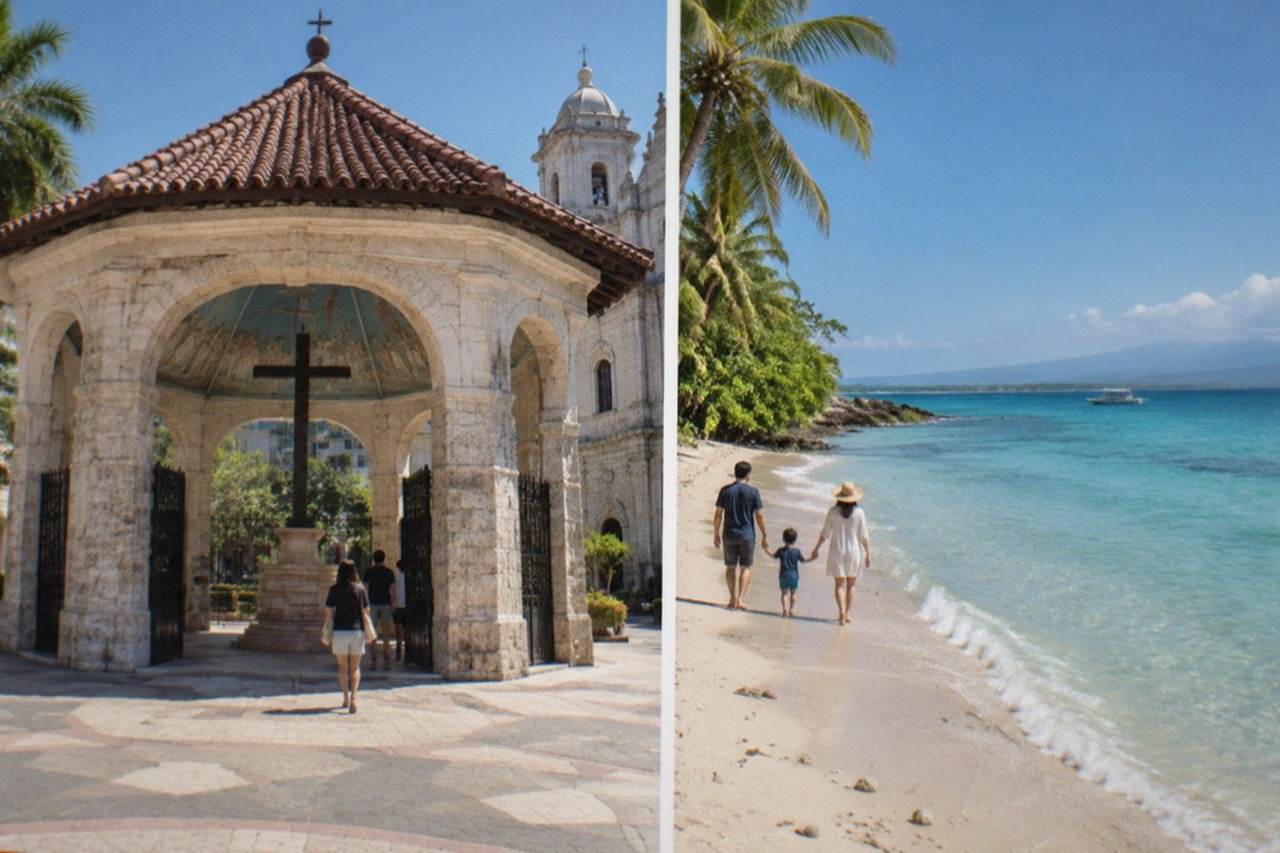
Cebu works well with kids of almost any age. Foreign visitors get 30 days visa-free, the dry season runs December to May, and most family attractions charge small local fees, from Magellan's Cross free to Tops Lookout at P100 per person, about US$2.
Cebu, an island province in the Central Visayas region of the Philippines, is one of the most workable tropical destinations in Asia for families. The province pairs a genuinely interesting colonial city with beach resorts on Mactan, waterfalls and whale sharks in the south, and ferry links to islands that make day trips easy. Fees are low by Western standards, English is widely spoken, and the airport is close to the main hotel zones. This guide lays out what a family actually does here, what it costs, and how to avoid the mistakes that make trips with children harder than they need to be.
Is Cebu A Good Destination For Families With Kids?
Yes. Cebu suits families with children from toddlers to teenagers, because the province combines safe, shallow swimming areas on Mactan with genuinely exciting wildlife experiences in the south, all connected by short travel times. Foreign nationals including US, UK, Australian and EU passport holders receive an initial 30-day visa-free stay, and families staying under a year do not pay the Philippine travel tax on departure. The main trade-offs are heat, traffic and the June-to-November rainy season.
The practical case for Cebu is variety within short distances. A family can base in one hotel in Cebu City or on Mactan and reach a heritage walk, a beach day, a waterfall and an aquarium-scale snorkelling spot without ever changing hotels. The Mactan-Cebu International Airport sits roughly 13 to 15 km from the main city hotel areas, which keeps arrival day short even with tired children.
The honest caveats matter too. Sidewalks are uneven or missing in much of Cebu City, so strollers work better in malls and resorts than on heritage streets. The midday heat is real: PAGASA's 1991-2020 normals for the Mactan station put the annual mean temperature at 28.1 C, which means sightseeing needs to happen early. And the rainy season, June to November, brings the typhoon months with it, so school-holiday timing matters.
For a deeper comparison of seasons, see the best time to visit Cebu, and for a ready-made plan, the Cebu with kids itinerary breaks the province into a day-by-day route.
What Are The Best Things To Do In Cebu With Children?
The strongest family picks in Cebu split into three groups: heritage sites in Cebu City that cost little or nothing, highland viewpoints around Busay that pair well with cool morning air, and south-coast nature experiences including whale sharks, waterfalls and the Moalboal sardine run. Most entrance fees run from free to about P200 per person, roughly US$4 at most, so a full sightseeing day costs a family less than a single museum ticket in Europe.
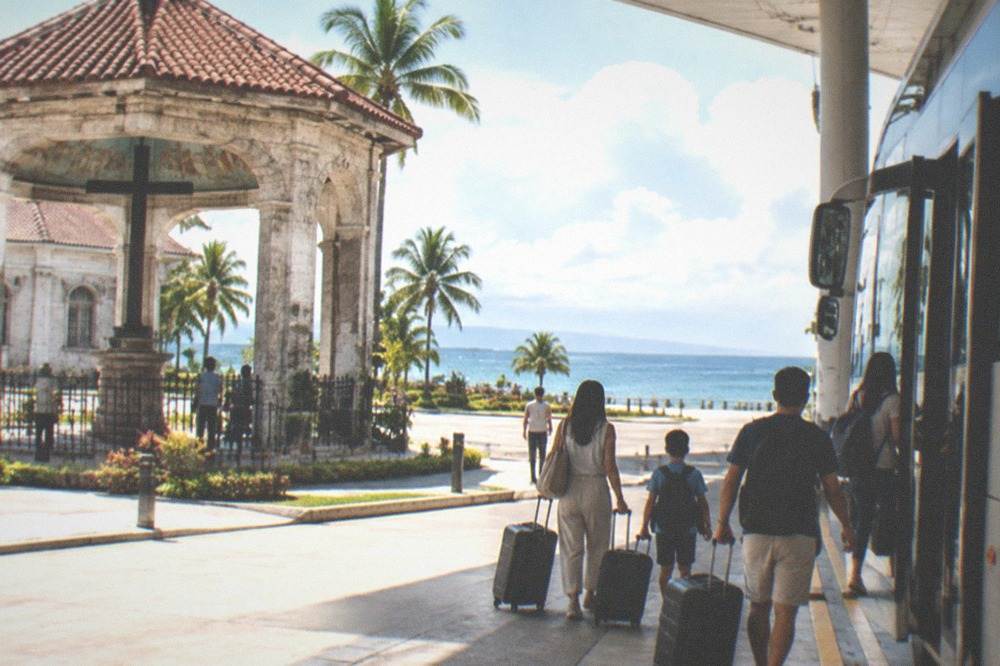
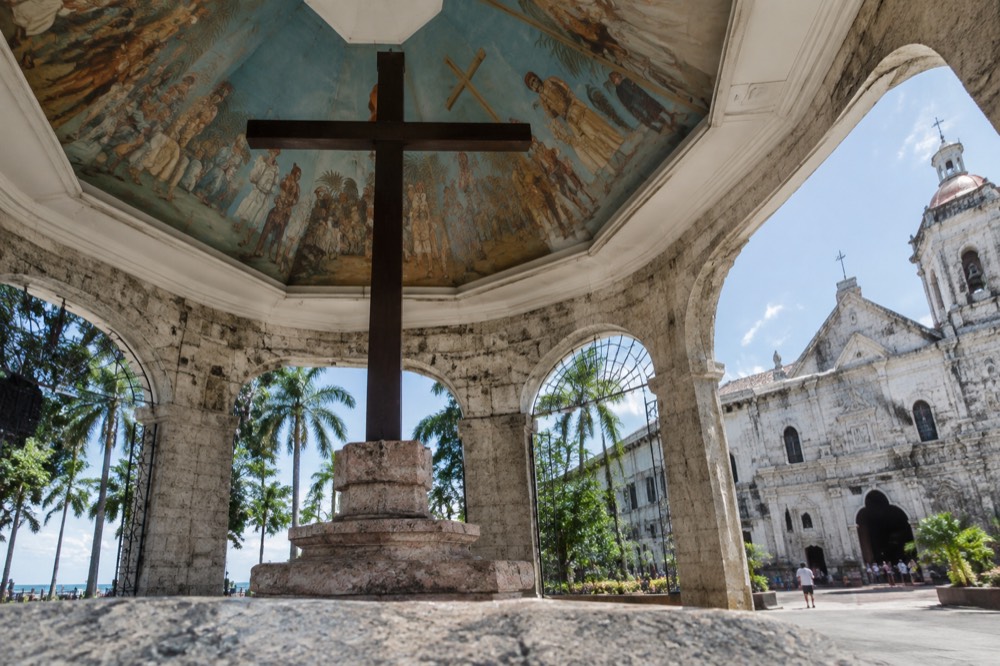
In the city, the core heritage cluster is walkable in a morning. Magellan's Cross is free to see, the Basilica Minore del Santo Niño charges no entry fee, and Fort San Pedro charges P50 (about US$0.8) regular with P40 (about US$0.6) for students and seniors, the rates Cebu City confirmed in its 2026 fee review. The coral-stone fort has lawns and cannons that children actually enjoy, and the shaded interior breaks the heat.
Up in the hills above the city, Tops Lookout is open 24 hours and charges P100 (about US$1.6) regular, P70 (about US$1.1) for seniors and persons with disabilities, with children under two free, according to the operator's own site. Sirao Flower Garden, the so-called little Amsterdam, charges about P100 (about US$1.6) per person, and the Temple of Leah about P120 (about US$1.9) on weekdays and P150 (about US$2.4) on weekends. These three sit along the same Busay road, so one habal-habal or van loop covers all of them.
Further out, the headline family experiences are wildlife ones. The Oslob whale shark interaction runs from about 6 AM to noon and charges P1,000 (about US$15.9) per foreign visitor, P500 (about US$8.0) per Filipino, boat and guide included, with a minimum viewing distance of about four metres, no sunscreen allowed and life jackets mandatory. Tumalog Falls charges about P50 (about US$0.8) entrance. Kawasan Falls in Badian charges about P200 (about US$3.2) for Level 1 swimming access, while the full canyoneering route, which suits only older teenagers, runs roughly P1,500 (about US$24) to P2,000 (about US$32) with a Badian-accredited guide. The Moalboal sardine run, a permanent school of fish a few metres off Panagsama Beach, needs only a P100 (about US$1.6) environmental user fee to swim or snorkel.
The table below pulls the family-relevant fees together in one place:
| Attraction | Entry fee | Notes for families |
|---|---|---|
| Magellan's Cross, Cebu City | Free | Open pavilion, 10-minute stop |
| Fort San Pedro | P50 (about US$0.8) regular, P40 (about US$0.6) student/senior | Shaded lawns, cannons, rest rooms |
| Tops Lookout, Busay | P100 (about US$1.6) adult, under 2 free | Open 24 hours, cool mornings |
| Sirao Flower Garden | about P100 (about US$1.6) | Photo gardens, steep steps |
| Temple of Leah | about P120 (about US$1.9) weekday, P150 (about US$2.4) weekend | Hours shortened since April 2026, confirm locally |
| Oslob whale sharks | P1,000 (about US$15.9) foreign, P500 (about US$8.0) local | 6 AM to noon, briefing mandatory, minimum age rules apply to swimmers |
| Tumalog Falls | about P50 (about US$0.8) | Shallow basin, habal-habal from Tan-awan about P50 (about US$0.8) to P100 (about US$1.6) each way |
| Kawasan Falls Level 1 | about P200 (about US$3.2) | Swimming only; cliff jumping now banned at the main basin |
For a full inventory of the province's highlights beyond the family lens, the site's things to do in Cebu page is the root guide, and the Cebu beaches guide covers which swimming spots have gentle conditions for small children.
Which Cebu Tours Work Best For Families?
For most families, the best-fit tours are a short city tour, a food-market walk and a private Bohol countryside day trip, because all three keep travel time short, run in the morning when children are freshest, and avoid the very early starts that whale shark day trips demand. Tour prices and ratings render from the live listings, so check the operator's current page before booking.
The whale shark day tours from Cebu City, superb as they are, typically run ten hours or more, which suits older children better than toddlers.
A private or small-group format is worth the premium with children. The 3-hour small group Cebu City tour covers the heritage core without the fatigue of a full-day circuit, and the Bohol countryside private tour from Cebu City pairs the Loboc river cruise and the tarsier sanctuary with a same-day ferry return, a day that children consistently rate highly.
The food angle deserves more attention than families usually give it. Philippine markets are loud, crowded and confusing to navigate alone, which is exactly why a guide helps. The Cebu market and food tour turns Carbon market into an accessible walk, and the operator's listing carries the current price and availability: Check availability.
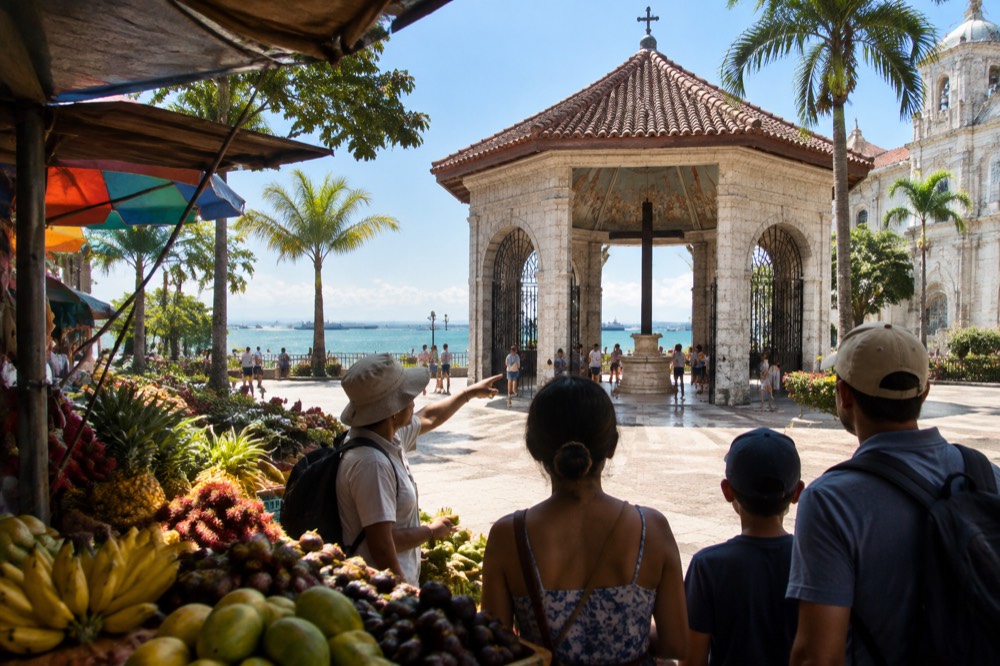
For the whale shark day, the join-in option from Cebu City includes a Tumalog Falls stop and an early morning departure; its price is unpublished on the live listing, so the live page is the only reliable source. The same applies to the Moalboal canyoneering and sardine-run combos, which suit confident swimmers in the family. Whichever tour a family picks, the short city formats tend to be the ones repeated on a second visit, because they slot between beach days without wrecking nap schedules.
Between the city tour and the market walk, a family covers most of what makes Cebu distinctive in a single morning, and both finish early enough that an afternoon pool session is still on the table. That balance of activity and rest is what separates a family trip that works from one that ends in tears by Wednesday.
Where Should A Family Stay In Cebu?
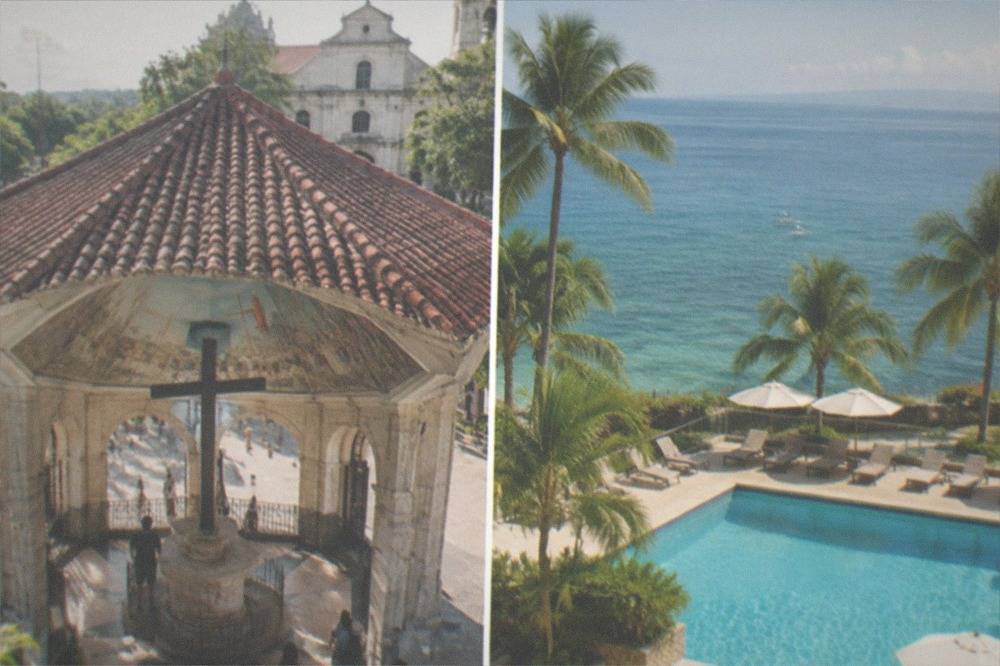
Most families should stay either on Mactan Island, where resort pools and calm beachfront keep small children happy and the airport is minutes away, or in Cebu City around the Ayala or IT Park area, which puts heritage sites, malls and restaurants within a short drive and costs less than the beach resorts. A third option, Moalboal or Oslob in the south, only makes sense once the family has already done the city and wants two or more days of water activities.
Mactan's resort zone is the low-effort choice. Lapu-Lapu City, the Mactan municipality, counted 497,604 residents at the 2020 census, and its beachfront along Mactan Channel and the Camotes Sea holds the province's densest cluster of family resorts with pools, kids' clubs and shallow swimming areas. The trade-off is distance: heritage Cebu City is a bridge crossing away, and bridge traffic can stretch a short drive considerably. More of these guides are collected on Cebu Travel Guide.
Cebu City, by contrast, puts a family next to the heritage cluster, the big malls with air-conditioned food courts, and the mountain road to Tops and Sirao. It is also the base for the south-coast day tours, which depart from the city before dawn. The family friendly resorts in Cebu page lists specific properties with pools and family rooms.
One structural point that confuses first-time visitors: Cebu City, Lapu-Lapu and Mandaue are highly urbanized cities, administratively independent of Cebu Province even though they sit on the same island group. Hotel addresses and transport apps all behave normally regardless, but it explains why "Cebu" appears on maps in overlapping ways.
How Do You Get Around Cebu With Children?
The realistic family transport mix in Cebu is Grab or a taxi for city journeys, the MyBus airport service for arrival and departure days, and a private van or an organised tour for anything south of the city, because the Ceres bus network, while cheap, runs three to four hours to Oslob and is hard work with small children. Jeepneys are fun for a short ride with older kids and cost a peso fare set by national regulation.
From the airport, MyBus runs between MCIA and SM City Cebu roughly every 20 minutes, from 7 AM to 10 PM airport-side, charging P30 (about US$0.5) to P50 (about US$0.8) depending on destination, with a separate Lapu-Lapu Public Market route running around the clock. The official airport transport guide confirms these fares. Yellow airport taxis flag down at about P70 (about US$1.1), white metered city taxis at about P40 (about US$0.6) plus roughly P14 (about US$0.2) per kilometre. Grab operates across Cebu City, Mandaue and Lapu-Lapu with designated airport pickup zones.
Jeepney minimum fares were adjusted nationally in late September 2026: traditional jeepneys charge roughly P13 (about US$0.2) to P14 (about US$0.2) for the first four kilometres, modern ones P15 (about US$0.2) to P17 (about US$0.3), though coverage of Cebu specifically was not confirmed in the fare announcement. A jeepney ride is a genuine experience for school-age children, best done once, short, and off-peak.
For the south, Ceres Liner buses leave the Cebu South Bus Terminal for Oslob roughly nine or more times daily, taking about 3.5 to 4.5 hours and costing about P145 (about US$2.3) to P250 (about US$4.0), while Moalboal takes 2.5 to 3.5 hours at about P120 (about US$1.9) to P210 (about US$3.3). Those are honest figures, and they are also the reason most families book a tour van instead. The getting around Cebu guide has the full transport picture, and the Cebu airport guide covers arrivals in detail.
| Transport option | Typical cost | Family verdict |
|---|---|---|
| MyBus airport to SM City Cebu | P30 (about US$0.5) to P50 (about US$0.8) per person | Best value on arrival day, air-conditioned |
| White metered taxi | about P40 (about US$0.6) flag-down plus about P14 (about US$0.2) per km | Easiest with car seats unavailable, use Grab or taxi rank |
| Yellow airport taxi | about P70 (about US$1.1) flag-down | Higher rate, dedicated airport queue |
| Jeepney, short city hop | about P13 (about US$0.2) to P17 (about US$0.3) minimum | A fun one-off with older kids |
| Ceres bus to Oslob | about P145 (about US$2.3) to P250 (about US$4.0) | 3.5-4.5 hours, only for patient families |
| Private tour van to Oslob or Moalboal | tour-dependent, see listings | The default family choice, door-to-door |
What Does A Family Trip To Cebu Cost?
A mid-range family of four can plan on attraction fees of roughly P500 to P1,500 (about US$8 to US$24) per sightseeing day, since most family attractions charge P50 (about US$0.8) to P200 (about US$3.2) per person and only the whale shark interaction reaches P1,000 (about US$15.9) per foreign adult, so the big costs are accommodation, tours and intercontinental flights rather than entry fees. Food is inexpensive, and the visa-free, travel-tax-exempt status of foreign tourists removes two charges families often budget for by mistake.
Two corrections to common budgeting errors. First, foreign tourists staying under a year are exempt from the Philippine travel tax, a charge that falls on Filipinos and residents, not on visiting families. Second, the airport passenger service charge is bundled into airline tickets, so there is no terminal-fee scramble at check-in with children in tow.
| Budget line | Planning figure | Basis |
|---|---|---|
| Heritage day in Cebu City, family of four | about P200 (about US$3.2) to P400 (about US$6.4) total | Fort San Pedro fees plus free sites |
| Busay highlands loop, family of four | about P400 (about US$6.4) to P600 (about US$9.6) plus transport | Tops, Sirao and Temple of Leah fees |
| Oslob whale shark day, two foreign adults | P2,000 (about US$32) in local fees | P1,000 (about US$15.9) per foreign visitor, boat and guide included |
| Kawasan Falls swimming, family of four | about P800 (about US$12.7) | P200 (about US$3.2) per person Level 1 entrance |
| Moalboal sardine snorkel, family of four | about P400 (about US$6.4) | P100 (about US$1.6) environmental user fee each |
| Bohol day trip by ferry, per adult | about P960 (about US$15.3) tourist class each way | OceanJet fares from 21 Sept 2026, about 2 hours |
The Cebu budget and costs guide expands these lines into full daily budgets, and the ferries from Cebu page covers the Bohol crossing families most often add to the trip.
When Is The Best Time To Visit Cebu With Kids?
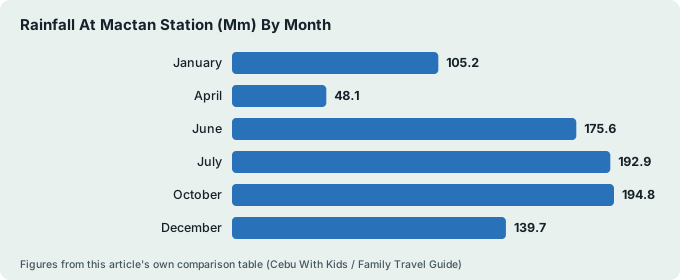
The best family window in Cebu is December to May, the PAGASA dry season, with the sweet spot in the cool dry months of December to February when the December rainfall normal at the Mactan station is 139.7 mm against October's 194.8 mm peak, and the risk of typhoon disruption is at its lowest. Families tied to Northern Hemisphere summer holidays land in the rainy season, June to November, which is workable but needs flexible plans and travel insurance.
The monthly rainfall picture matters more than averages suggest. The Mactan station normals show April as the driest month at 48.1 mm, while October is the wettest at 194.8 mm, with every rainy-season month from June through November well above the April figure. The typhoon season runs June to November, peaking roughly July to October, and the Visayas carries a high landfall risk in November and December.
| Month | Rainfall at Mactan station (mm) | Family planning note |
|---|---|---|
| January | 105.2 | Sinulog month, third Sunday, crowds and colour |
| April | 48.1 | Driest month of the year |
| June | 175.6 | Rainy season begins |
| July | 192.9 | Peak typhoon-risk period |
| October | 194.8 | Wettest month of the year |
| December | 139.7 | Dry season starts, festive atmosphere |
One festival note for families: the Sinulog Grand Parade falls on the third Sunday of January, 17 January in 2027, with the Cebu City Sports Center as the main venue. It is a spectacular thing for children to witness, but the city is at its most crowded, so book rooms months ahead. The Sinulog festival guide and the typhoon season guide cover both sides of the calendar.
Is Cebu Safe For Families?
Cebu carries no destination-specific travel warning: the US State Department advisory for the Philippines is Level 2, exercise increased caution, applied country-wide with its highest-risk designations reserved for parts of Mindanao and the Sulu Archipelago, and the UK Foreign Office names no Cebu-specific restrictions at all. The realistic family risks are ordinary ones, heat, traffic, water safety and jellyfish in some months, plus weather disruption during the typhoon season.
Two events shaped 2025-2026 safety coverage and are worth putting in context. The magnitude 6.9 earthquake of 30 September 2025, epicentred off Bogo City in northern Cebu, damaged several northern heritage churches and caused about 80 deaths, but the Department of Tourism declared Cebu, Bantayan Island and Malapascua open to visitors by late October 2025, with the ports fully operational. Typhoon Tino in early November 2025 brought severe flooding, yet the DOT again confirmed the core tourism zones of Cebu City and Mactan were largely unaffected and open.
Practical family safety is mostly common sense. Use reef-safe sunscreen, which is mandatory at the Oslob interaction anyway, since sunscreen is banned outright there. Keep children within arm's reach at waterfalls, where rocks are slick and cliff jumping is now banned at the Kawasan Level 1 basin. At the whale shark briefing, listen for the four-metre minimum distance rule, and note that only licensed spotters feed the animals. The Cebu safety guide goes deeper, and the whale shark ethics discussion helps families decide whether the interaction fits their values.
What Should Families Know Before Flying To Cebu?
Before departure, a family of visa-free nationals needs passports valid at least six months beyond the stay, an onward or return ticket, and a free eTravel registration completed within 72 hours before arrival for every passenger, including children; the initial stay granted is 30 days, extendable with the Bureau of Immigration, and no visa is needed in advance for US, UK, Australian and EU passports. The eTravel QR code is checked at boarding, and registration on the official site is free.
The eTravel point catches families out: every arriving passenger, adults and children alike, needs their own registration, and fake third-party sites charging fees circulate regularly, which the Bureau of Immigration warns about. The official site is the only one to use. The Philippines visa and eTravel guide walks through the form.
On the ground, Mactan-Cebu International Airport has two terminals, Terminal 1 for domestic flights and Terminal 2, opened in 2018, for international flights, connected by walkway, with a second runway in operation since January 2025. New routes added through 2025 and 2026, including Jetstar to Brisbane and Vietnam Airlines to Hanoi, have widened the arrival options considerably.
For families weighing Cebu against its neighbours, the Cebu versus Bohol comparison is the most common question, since the two provinces share a two-hour ferry link and split neatly between city energy and countryside calm.
Common Questions About Cebu Family Travel
Is Cebu good for kids?
Yes. Cebu offers shallow resort beaches on Mactan, low-cost heritage sites in Cebu City, and wildlife experiences like the Moalboal sardine run that work for school-age children, all within short travel distances of one another.
What are the best things to do in Cebu with children?
The strongest picks are the Cebu City heritage cluster including Fort San Pedro at P50 (about US$0.8) entry, the Busay highlands loop to Tops Lookout and Sirao Flower Garden, and a south-coast day to Oslob, Tumalog Falls or Moalboal, with the Bohol ferry day trip as the easiest island add-on.
How much does a family trip to Cebu cost?
Attraction fees are small, mostly P50 (about US$0.8) to P200 (about US$3.2) per person with only the whale shark interaction at P1,000 (about US$15.9) per foreign visitor, so accommodation, tours and flights dominate the budget. Foreign tourists staying under a year are exempt from the Philippine travel tax.
Do children need eTravel registration for the Philippines?
Yes. Every arriving passenger, including children, must be registered on the official eTravel site within 72 hours before arrival, free of charge, and the QR code is checked at boarding.
When is the worst time to visit Cebu with kids?
The June-to-November rainy season, with October the wettest month at 194.8 mm of rain at the Mactan station and typhoon risk peaking roughly July to October, is the hardest window, though trips remain possible with flexible plans.
Can kids swim with whale sharks in Oslob?
The interaction is regulated with mandatory briefings, life jackets and a minimum distance of about four metres, and the session runs about 30 minutes in the morning. Age and swimming requirements are set at the briefing, so confirm them with the operator before booking for young children.
A family week in Cebu, planned around the dry season, a Mactan or city base and one or two guided days, delivers more variety per travel hour than almost anywhere else in the Philippines, and the fees listed here mean the sightseeing budget stays refreshingly small.