Transportation In Cebu (Grab, Jeepney, Taxi)
Cebu, an island province in the Central Visayas region of the Philippines, moves on jeepneys, taxis, ride-hailing apps, an emerging bus rapid transit line and a web of ferries. This guide covers what each option costs in 2026, where each one works best, and how to string them together.
Short answer
For many visitors, Grab is the easiest way to get around Cebu, jeepneys are the cheapest at about P13 (about US$0.2) to P14 (about US$0.22) for the first 4 km, and the CBRT bus is worth trying on its IT Park to Il Corso route. Buses from the South Bus Terminal reach Oslob and Moalboal, and fastcraft ferries run to Bohol from Pier 1.
Cebu, an island province in the Central Visayas region of the Philippines, is a place where a single morning can involve a jeepney, a ferry and a ride-hailing app, sometimes in that order. The province stretches far beyond Cebu City: Lapu-Lapu and Mandaue are separate highly urbanized cities on the Mactan Channel, and the south coast runs all the way down to Oslob and Badian. Getting the transport mix right saves both money and hours.
This guide walks through every mainstream option, with the fares that are actually verified as of late 2026. Where a figure is disputed or unverified, it says so plainly, because a confident wrong number is worse than an honest blank.
What Are The Main Ways Of Getting Around Cebu?
The main ways of getting around Cebu are jeepneys for short city hops, Grab and metered taxis for door-to-door trips, the partially operating CBRT bus along its IT Park to Il Corso route, Ceres buses from the South Bus Terminal for the south coast, and ferries from Pier 1 for Bohol and the neighboring islands. Motorbike rentals and private vans fill the gaps, and the CCLEX bridge links Cebu City to Mactan from the south. No single option covers everything well.
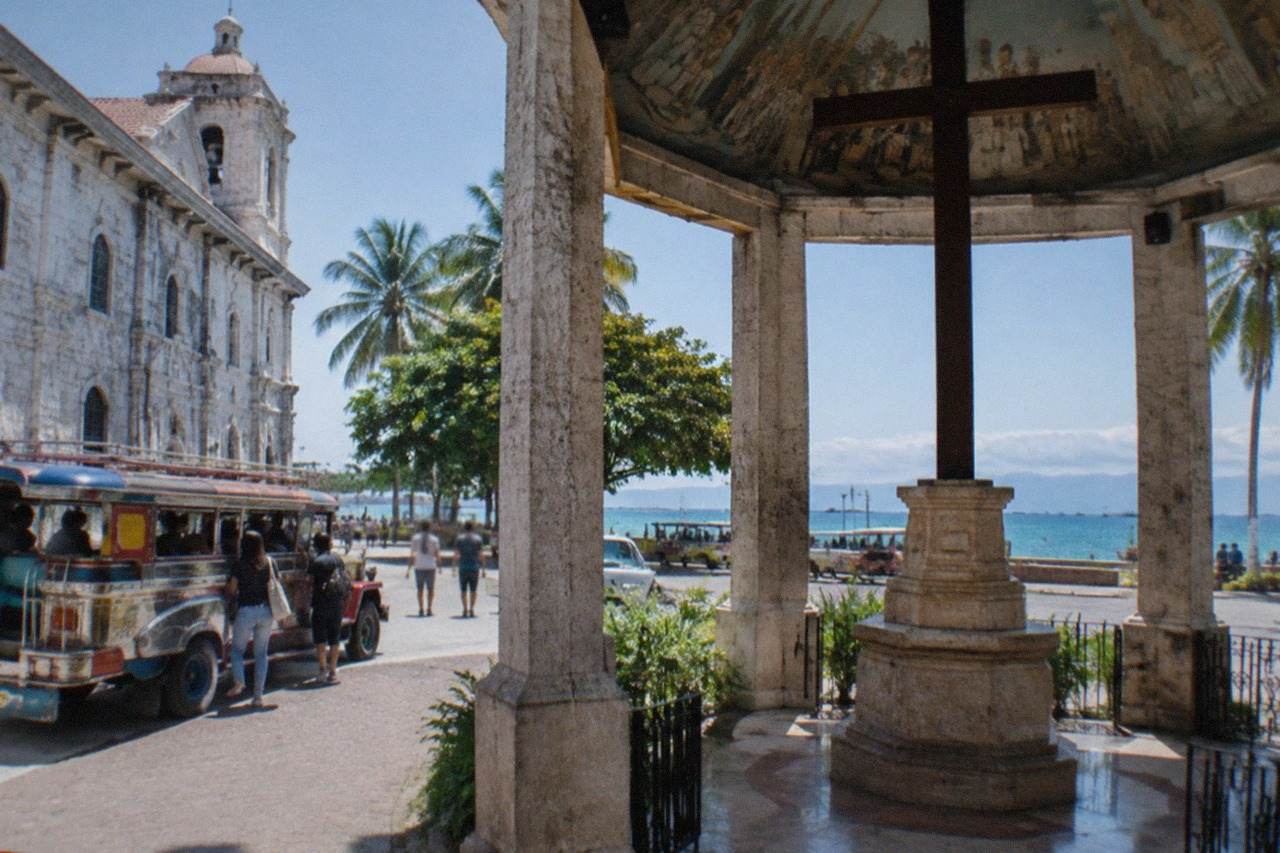
Jeepneys win on price and density. They run fixed routes, you pay onboard, and you flag one down from the roadside. The catch is route knowledge: destinations are painted on the side, and first-time visitors usually learn two or three routes and stick to them. A free walking tour is one low-stakes way to pick up the system, and the Cebu itinerary guide shows which routes a first visit actually needs.
Grab and taxis handle the trips jeepneys cannot: airport runs, late nights, cross-city journeys with luggage. Then there is the CBRT, Cebu's bus rapid transit, which began partial operations in March 2026 and is worth understanding before you believe any claim that Cebu "has a BRT" in the full sense.
| Mode | Best for | Verified fare basis | Main catch |
|---|---|---|---|
| Jeepney | Short city hops, fixed routes | P13 (about US$0.2) to P14 (about US$0.2) first 4 km (traditional) | Routes need local knowledge |
| Grab | Door-to-door, airport, nights | App shows upfront price | Surge pricing at peak times |
| Metered taxi | When Grab surge is high | Meter required by regulation | Always confirm the meter runs |
| CBRT bus | IT Park to Il Corso corridor | Free rides at launch; LTFRB fare listed alongside | Only partial operations since March 2026 |
| Ceres bus | South coast: Oslob, Moalboal | P120 (about US$1.9) to P250 (about US$4.0) depending on route | Departs from South Bus Terminal |
| Fastcraft ferry | Bohol day trips | P960 (about US$15.3) tourist class to Tagbilaran | From Pier 1, not the airport |
How Do Jeepneys Work In Cebu And What Do They Cost?
A traditional jeepney in Cebu charges roughly P13 (about US$0.2) to P14 (about US$0.22) for the first 4 km, or P15 (about US$0.24) to P17 (about US$0.27) on a modern air-conditioned unit, with about P2 (about US$0.03) per additional kilometer on traditional units and P2.40 (about US$0.04) on modern ones. These are the DOTr-approved fares effective 28 September 2026, though the approval's coverage of Region 7 has not been separately confirmed. You pay the driver or conductor onboard, usually via a hand-pass down the bench.
To put those peso figures in dollar terms: the traditional first-4 km fare runs P13 (about US$0.2) to P14 (about US$0.2), the modern equivalent P15 (about US$0.2) to P17 (about US$0.3), and the per-kilometer add-ons P2 (about US$0.0) and P2 (about US$0.0) respectively. The mechanics are simple. Flag the jeepney from the curb, board through the rear opening, pass your fare forward, and call out your stop or knock on the roof rail when you want off. Seats are benches facing each other, and at rush hour they fill completely. Hand your fare to the passenger nearest the driver and your change makes its way back the same way.
Modern jeepneys, the air-conditioned ones with sealed doors and card readers on some units, cost a little more than the traditional type. Both are cheap by any international standard, and for a visitor staying a week, learning the Colon to IT Park corridor and one route to the piers covers most needs. The Colon Street guide covers the downtown end of that corridor.
Jeepneys are also a cultural experience in themselves, and some tours build them in. A market and food walk through Cebu City, for instance, moves through the downtown markets where jeepney routes converge:
The operator has not published a price for that walk, so check the live listing rather than any figure quoted elsewhere. If a guided food crawl with a jeepney ride appeals, there is a free, tip-based option too, listed on GuruWalk with a route that includes riding a jeepney as part of the walk.
One practical note: carry small bills. Drivers make change, but a P1,000 (about US$15.9) note on a P14 (about US$0.2) ride at 7 AM will test everyone's patience, including yours.
Is Grab Available In Cebu, And How Does It Compare To Taxis?
Yes, Grab operates in Cebu, covering Cebu City, Mandaue and Lapu-Lapu on Mactan, with designated pickup zones at the airport terminals and upfront fares shown in the app before you book. Metered taxis remain an alternative, and the rule to hold them to is the meter: if a driver proposes a flat rate instead, decline and take the next cab in the queue. No official Cebu City taxi flag-down rate could be verified, so this guide deliberately quotes none.
Grab's advantage is certainty. The app names the price before you commit, the route is logged, and payment can be cash or card. The disadvantage is surge: when demand spikes, around Sinulog week, late evenings in IT Park, or a downpour, the price climbs and a metered taxi at the stand becomes the better deal. The Grab app in Cebu guide covers setup, common pickup points and how the airport zones work.
Taxis in Cebu are plentiful and mostly honest. The failures are concentrated in tourist zones: a proposed "fixed price" three or four times the metered fare is the classic move at the airport and pier areas. The counter is boring and effective: insist on the meter, and if refused, walk a few meters to the next cab.
For trips where neither Grab nor a taxi makes sense, a guided option removes the negotiation entirely:
Between the two, visitors settle into a rhythm: Grab for airport runs and nights out, taxis when the app surges, and jeepneys for everything in daylight hours.
What Is The CBRT Bus And Does Cebu Have A Real BRT?
The CBRT, Cebu's bus rapid transit system, began partial operations on 13 March 2026 on a single route from Il Corso on the South Road Properties to Cebu IT Park, using 17 buses that run in a short dedicated corridor near the South Bus Terminal and Capitol and in ordinary traffic elsewhere. Free rides were offered at launch, with the regulated LTFRB fare listed alongside, so check the current fare before boarding.
In peso terms, Cebu Daily News lists the LTFRB air-conditioned bus fare as P18 (about US$0.3) minimum for the first 5 km plus P3 (about US$0.0) per kilometer, P14 (about US$0.2) discounted, running alongside the free-ride schedules reported at launch.
The honest summary is that Cebu does not yet have a full BRT. Package 1, the 2.38 km dedicated section along N. Bacalso Avenue and Osmeña Boulevard, is built and in use. The rest of the route mixes with cars, and the World Bank restructured the project in 2026, cancelling later packages, with the loan closing 30 September 2026 and full operations now targeted for 2027 or later.
For a visitor, the practical question is whether the route helps you. If your hotel is near IT Park and your evening is at Il Corso or SM Seaside, it genuinely does, and the price is right either way. For anything off that corridor, the CBRT is a curiosity rather than a tool, and the getting around hub pages list the alternatives.
The launch got attention because it was free. The SunStar report of 12 March 2026 said free rides for one year; the commuter guide published days later showed the regulated fare running alongside free-ride windows. Both can be true at once, with free rides limited to certain hours, which is exactly why the advice is to check rather than assume.
How Do You Get From Mactan-Cebu Airport To Cebu City?
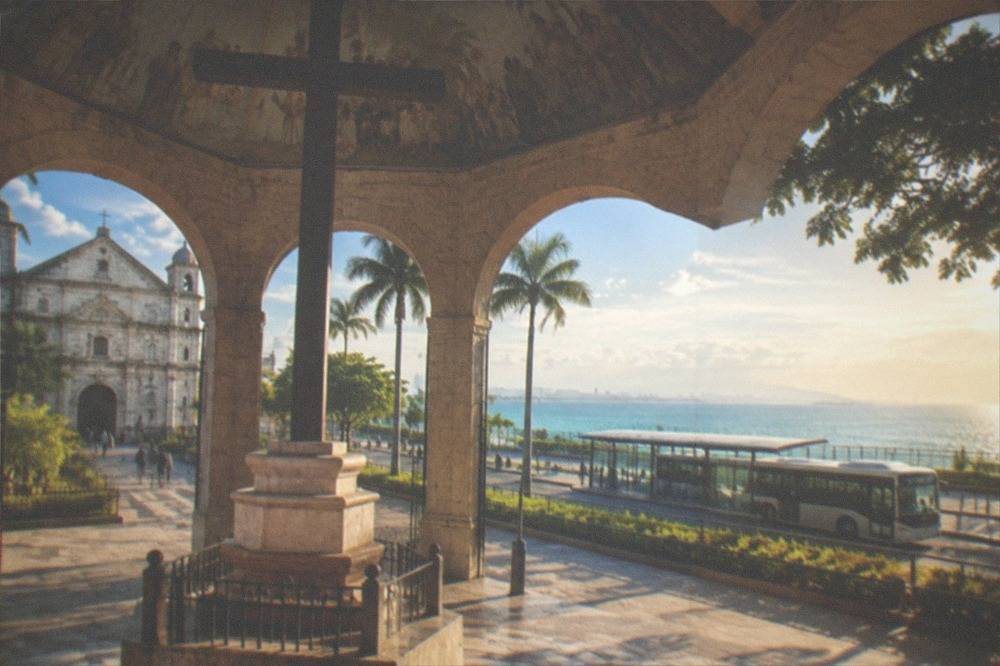
The main ways from Mactan-Cebu International Airport to Cebu City are the MyBus airport bus to SM City Cebu, Grab with designated pickup zones outside arrivals at both terminals, and metered taxis, including yellow airport-accredited units, from the arrivals queues. The airport sits on Mactan about 13 to 15 km from the city, and the drive runs roughly 25 to 60 minutes depending on bridge traffic.
MyBus is the budget play, with fares of P30 (about US$0.5) to P50 (about US$0.8) depending on destination. It runs from the airport to SM City Cebu roughly every 20 minutes, from 7 AM to 10 PM airport-side and 6 AM to 9 PM from SM, with a separate Lapu-Lapu Public Market route running around the clock. You pay onboard. From SM City Cebu, jeepneys, Grab and the CBRT corridor are all within reach, which is why the bus plus a short ride combination often beats a taxi outright.
Grab works well here precisely because the airport publishes its pickup zones: you walk to the zone, the app matches a driver, and the fare is fixed before you sit down. Taxi queues at both terminals are managed, and the same meter rule applies as anywhere in the city. The full breakdown, including terminal differences and the second runway that opened 30 January 2025, lives in the Cebu airport guide.
One structural fact worth knowing: Terminal 1 handles mostly domestic flights and Terminal 2 mostly international, and they are adjacent and connected. If your plan is a same-day onward move, the ferries from Cebu guide explains how Pier 1 fits into an arrival day.
| Airport option | Route | Fare basis | Operating window |
|---|---|---|---|
| MyBus | MCIA to SM City Cebu (via Parkmall) | P30 (about US$0.5) to P50 (about US$0.8) | Airport to SM 7 AM to 10 PM |
| MyBus return | SM City Cebu to MCIA | Same fare basis | 6 AM to 9 PM |
| MyBus Lapu-Lapu route | MCIA to Lapu-Lapu Public Market | Fare varies by segment | Runs 24/7 |
| Grab | Door to door, both terminals | App upfront pricing, surge applies | Designated pickup zones at arrivals |
| Metered taxi | Airport to city | Meter required; no verified Cebu flag-down figure published here | Queues at both terminals |
How Do You Travel South To Oslob, Moalboal And Kawasan Falls?
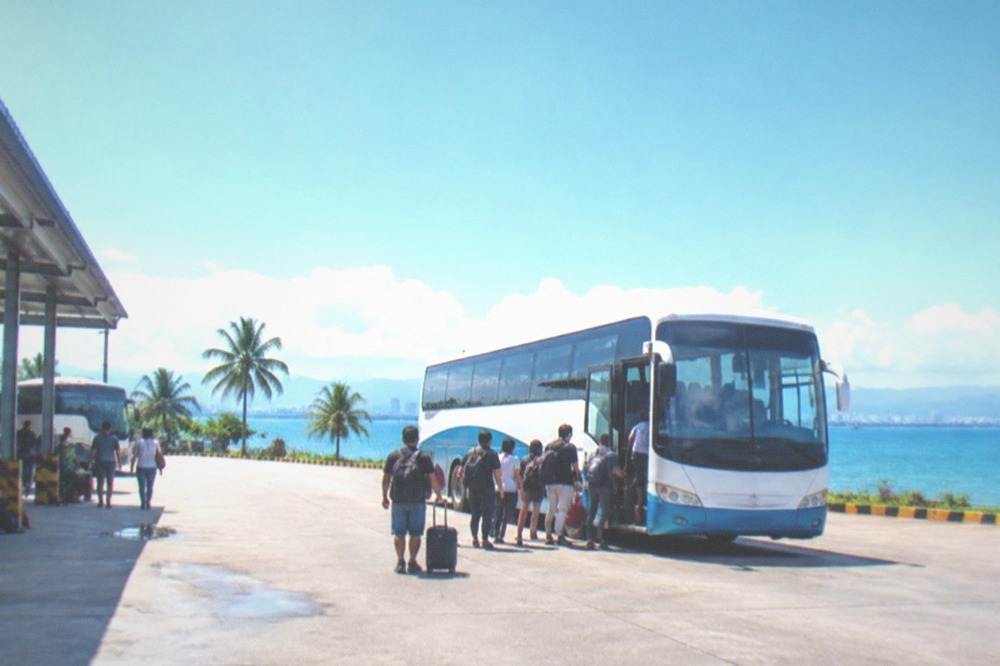
You travel south from Cebu by Ceres bus from the Cebu South Bus Terminal: Oslob is reached on the Bato via Oslob route in about 3.5 to 4.5 hours, and Moalboal in about 2.5 to 3.5 hours, with buses running multiple times daily and fares paid onboard or at the terminal. For whale sharks at Oslob, the earliest departures matter, because the interaction window runs from about 6 AM to midday.
The fares sit in the low hundreds of pesos: roughly P145 (about US$2.3) to P250 (about US$4.0) to Oslob and P120 (about US$1.9) to P210 (about US$3.3) to Moalboal. The South Bus Terminal on N. Bacalso Avenue is the hub for the whole south coast. Oslob buses run the Bato via Oslob route with departures spread across the day; Moalboal buses leave roughly every 30 to 45 minutes. Air-conditioned and ordinary buses both run, at different price points within the ranges above. The Oslob whale sharks guide covers the timing logic in detail, and the Moalboal day trip guide does the same for the sardine run.
Many visitors skip the DIY bus version and book a tour instead, which bundles the early departure, the environmental fees and the guide. For Kawasan Falls and canyoneering, a guided package is not just convenient, it is how the regulated Badian route works:
That operator's price is not published, so the listing is the only reliable source. A full-day Kawasan Falls tour from Cebu City is the other common shape of the same trip:
Its price is likewise unpublished by the operator. Both matter because the south coast rewards an early start: buses fill, the canyoneering routes have caps, and the falls are at their quietest before mid-morning.
| Southbound destination | Bus route basis | Journey time | Fare range | Notes |
|---|---|---|---|---|
| Oslob (Tan-awan) | Bato via Oslob, Ceres Liner | About 3.5 to 4.5 hours | P145 (about US$2.3) to P250 (about US$4.0) | Multiple daily departures, earliest around 3 AM |
| Moalboal | Ceres Liner south coast | About 2.5 to 3.5 hours | P120 (about US$1.9) to P210 (about US$3.3) | Roughly every 30 to 45 minutes |
| Badian (Kawasan access) | South coast routes toward Bato | Varies by connection | Within the ranges above | Combine with habal-habal for the final leg |
What About Ferries To Bohol And The Nearby Islands?
Ferries to Bohol leave from Pier 1 in Cebu City, where OceanJet runs the fastcraft service to Tagbilaran in about 2 hours, with fares from 21 September 2026 carrying a 10 percent fuel surcharge, and Lite Ferries running slower RORO crossings of about 4 hours. Around 13 fastcraft sailings a day cover the route, and a small terminal fee applies at the pier.
In peso terms, OceanJet's post-surcharge fares are P960 (about US$15.3) for tourist or open-air class and P1,440 (about US$23) for business class, Lite Ferries runs from roughly P400 (about US$6.4) to P520 (about US$8.3), and the terminal fee is about P25 (about US$0.4). The fuel surcharge is new, dating from 21 September 2026, and some sailings were cut in mid-September for fuel cost reasons, so treat any schedule older than that with suspicion. SuperCat, which appears in older guides for this route, was not operating Cebu to Tagbilaran as of September 2026. The Cebu to Bohol ferry guide has the current picture, and the Bohol day trip guide shows how the crossing fits a single-day plan.
For islands closer to home, the pattern differs. Camotes and Bantayan are reached by ferry from northern piers, Olango by a short bangka crossing from Mactan, and Mactan's own island-hopping trips leave from various resorts along its east coast. The ferries from Cebu guide is the index for all of them.
| Cebu ferry route | Operator type | Journey time | Fare basis |
|---|---|---|---|
| Cebu City to Tagbilaran (Bohol) | OceanJet fastcraft | About 2 hours | P960 (about US$15.3) tourist, P1,440 (about US$23) business |
| Cebu City to Tagbilaran (Bohol) | Lite Ferries RORO | About 4 hours | P400 (about US$6.4) to P520 (about US$8.3) |
| Pier terminal fee | Applies at Cebu fast craft terminal | N/A | About P25 (about US$0.4) |
Should You Rent A Car Or Motorbike In Cebu?
Renting a car or motorbike in Cebu makes sense mainly for the south coast loop, the highlands around Busay and a self-driven Camotes trip, while inside Cebu City a rental is a liability: parking is scarce, traffic is dense, and Grab plus jeepneys covers nearly everything for less. The CCLEX bridge tolls, in force since 1 October 2025, run from Class 1M motorcycles up through Class 3 trucks.
The CCLEX changed the geography of the metro. The 8.9 km bridge, opened 30 April 2022, links Cebu City to Cordova on Mactan from the south, giving a third crossing alongside the two older bridges between Mandaue and Mactan. For airport runs from the south side of the city, it is often the fastest road. The one-way tolls are P68 (about US$1.1) for Class 1M motorcycles, P107 (about US$1.7) for Class 1 cars and SUVs, P214 (about US$3.4) for Class 2 buses and small trucks, and P321 (about US$5.1) for Class 3 large trucks.
Self-driving the south works because the coastal road is straightforward and the stops are obvious: Carcar, Moalboal, the Kawasan Falls turnoff, Oslob. The caveats are real, though. Rainy-season downpours arrive fast, night driving on provincial roads is best avoided, and habal-habal motorbike taxis cover the final legs to trailheads and falls for a few pesos. The Osmeña Peak guide and the south Cebu itinerary lay out the driving logic stop by stop.
For a first visit, the honest ranking is: no car in the city, a car or a driver for the south if your days are short, and buses if your budget is tighter than your schedule. The Cebu budget costs guide prices out the comparison.
| CCLEX vehicle class | One-way toll | In force since |
|---|---|---|
| Class 1M (small motorcycles) | P68 (about US$1.1) | 1 October 2025 |
| Class 1 (cars and SUVs) | P107 (about US$1.7) | 1 October 2025 |
| Class 2 (buses and small trucks) | P214 (about US$3.4) | 1 October 2025 |
| Class 3 (large trucks) | P321 (about US$5.1) | 1 October 2025 |
When Should You Skip Public Transport In Cebu Altogether?
Skip public transport in Cebu when timing is non-negotiable: the pre-dawn departure for Oslob's whale shark window, a same-day Bohol round trip built around ferry schedules, or any day that stacks three south-coast stops into limited daylight. In those cases a tour or a private transfer earns its price, because a missed window in Oslob cannot be recovered later in the day, and the interaction area winds down by about midday.
The whale shark session is the clearest example. Watching runs roughly 6 AM to 12 PM with sightings, not schedules, as the binding constraint, and in late May 2026 the sharks were absent from Tan-awan for about four days when plankton moved. A tour operator monitoring conditions saves you a 3 AM bus ride on a day with no sharks. The whale shark ethics discussion is worth reading before booking anything.
The same logic applies to canyoneering at Kawasan. The Badian route is LGU-regulated, guides are required, and weather closures happen, so a package with a licensed operator handles the moving parts. The Kawasan Falls guide explains the route rules, including the cliff-jumping ban at the main basin.
Everything else, honestly, is easier than it looks from abroad. Jeepneys look chaotic and are not. Grab looks like a lifeline and is one. The CBRT is new and worth a ride while it is cheap. This site, Cebu Travel Guide, keeps the fares on this page current as they change.
Common Questions About Transportation In Cebu
Is Grab available in Cebu?
Yes. Grab operates across Cebu City, Mandaue and Lapu-Lapu, including designated pickup zones at Mactan-Cebu International Airport. Fares are shown upfront in the app and can surge at peak times.
How much does a jeepney ride cost in Cebu?
From 28 September 2026, traditional jeepneys charge about P13 (about US$0.2) to P14 (about US$0.2) for the first 4 km plus around P2 (about US$0.0) per additional kilometer; modern air-conditioned units start at about P15 (about US$0.2) to P17 (about US$0.3) plus P2 (about US$0.0) per kilometer. Whether the national approval covers Region 7 has not been separately confirmed, so treat the posted onboard fare as final.
Does Cebu have a bus rapid transit system?
Partially. The CBRT began initial operations on 13 March 2026 on a single Il Corso to IT Park route, mixing a short dedicated corridor with ordinary traffic. Free rides were offered at launch; the regulated fare listed alongside is P18 (about US$0.3) minimum for the first 5 km plus P3 (about US$0.0) per kilometer. Full operations are not expected before 2027.
How do I get from Mactan-Cebu Airport to Cebu City?
Take the MyBus to SM City Cebu for P30 (about US$0.5) to P50 (about US$0.8), use Grab from the designated pickup zones, or join the metered taxi queue at arrivals. The drive is about 13 to 15 km and takes 25 to 60 minutes depending on traffic.
Can I take a bus from Cebu to Oslob or Moalboal?
Yes. Ceres buses leave from the Cebu South Bus Terminal: about P145 (about US$2.3) to P250 (about US$4.0) to Oslob (3.5 to 4.5 hours) and about P120 (about US$1.9) to P210 (about US$3.3) to Moalboal (2.5 to 3.5 hours), with multiple daily departures and payment onboard or at the terminal.
Is it easy to take a ferry from Cebu to Bohol?
Yes. OceanJet fastcraft runs from Pier 1 to Tagbilaran in about 2 hours, at P960 (about US$15.3) tourist class or P1,440 (about US$23) business class after the September 2026 fuel surcharge, with a terminal fee of about P25 (about US$0.4). Lite Ferries runs slower RORO crossings from about P400 (about US$6.4) to P520 (about US$8.3).