Best Photography Spots In Cebu
Cebu, the island province in the Central Visayas region of the Philippines, packs colonial churches, mountain lookouts, turquoise waterfalls and chaotic street markets into one compact frame. This guide lists the best photography spots in Cebu, what each one costs to enter, and when the light is right.
Short answer
The best photography spots in Cebu are Tops Lookout for the city panorama, the Basilica del Santo Niño and Magellan's Cross for heritage, Sirao Flower Garden for colour, Kawasan Falls for turquoise water, the Oslob whale shark area for wildlife, and Colon Street and Carbon Market for raw street work. Most charge small entry fees of P50 (about US$0.8) to P150, (about US$2.4) and the dry season from December to May gives the most reliable light.
Cebu, an island province in the Central Visayas region of the Philippines, gives a photographer more variety per kilometre than almost anywhere in the country. Within a single day you can shoot a coral-stone fort that traces its origins to 1565 in the morning, a flower garden in the hills at midday, and a city panorama from a mountaintop lookout at dusk. The province's own tourism material leans on this range, and it is real: heritage, highlands, waterfalls and sea all sit within a few hours of each other on one island. This guide from Cebu Travel Guide walks through the best photography spots in Cebu, what each costs, when the light works, and which ones need early starts.
Where Are The Best Photography Spots In Cebu For A City Panorama?
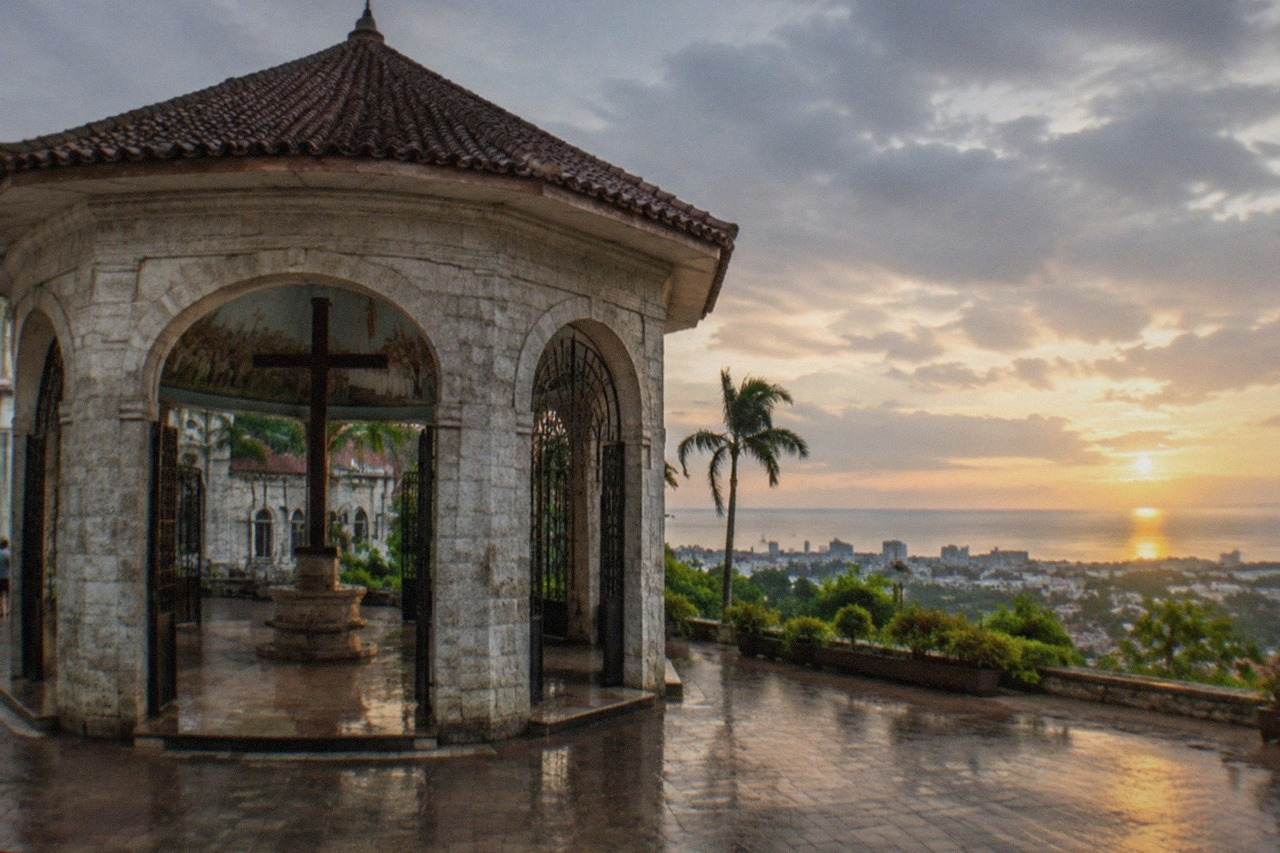
The best photography spots in Cebu for a city panorama are Tops Lookout in Busay, the Temple of Leah terrace just up the road, and the Skydeck at Nustar on the waterfront. Tops is open 24 hours a day and looks down over the whole of Cebu City and the Mactan Channel. The Temple of Leah, a grand stone complex built as a monument of love, sits on the same ridge. Nustar's glass Skydeck opened on 1 February 2026 and gives a modern river-of-lights view after dark.
Tops Lookout, officially The Circle at TOPS, is the classic shot. The operator's own site confirms 24-hour access, P100 (about US$1.6) regular entry, P70 (about US$1.1) for seniors and visitors with disabilities, and free entry for children under two. Photographers who want the panorama without a crowd go on a weekday and arrive an hour before sunset, shoot the blue hour as the city lights come on, and stay past dark. A shuttle plus entry combination from IT Park is listed at P200 (about US$3.2) for anyone without a car. The highlands around Cebu City are covered in more depth in the Cebu highlands and viewpoints guide.
The Temple of Leah, ten minutes further along the same Busay ridge, is a different mood entirely. Its colonnades, lion statues and hilltop altar read like a Mediterranean temple transplanted to a tropical ridge, and the late afternoon side light makes the stone glow. Entry is about P120 (about US$1.9) on weekdays and P150 (about US$2.4) at weekends. Note that its opening hours were shortened from April 2026, so confirm the current closing time before a late shoot. There is no official published price list, so treat the figures above as recent reported rates and check at the gate.
Nustar's Skydeck is the newest option. It opened on 1 February 2026 as a glass walkway attraction on the South Road Properties waterfront, and it faces the growing skyline across the water. It suits night photographers who want reflections rather than the distant haze that can soften long lens work from the hills.
| Panorama spot | Area | Entry fee | Best light |
|---|---|---|---|
| Tops Lookout | Busay, Cebu City | P100 (about US$1.6) regular | Sunset into blue hour |
| Temple of Leah | Busay, Cebu City | About P120 (about US$1.9) weekday, P150 (about US$2.4) weekend | Late afternoon side light |
| Nustar Skydeck | South Road Properties | Not published by the operator | After dark |
| Sirao Flower Garden | Busay, Cebu City | About P100 (about US$1.6) | Morning to avoid haze |
Which Heritage Sites In Cebu City Are Worth Photographing?
The heritage sites in Cebu City most worth photographing are Magellan's Cross, the Basilica Minore del Santo Niño, Fort San Pedro and the Heritage of Cebu Monument, all within a short walk of each other in the old downtown. Magellan's Cross is free to visit, the Basilica's façade and belfry are open to view from the plaza, and Fort San Pedro charges a small entry fee with concessions for students and seniors. Together they form the densest concentration of photogenic history anywhere in the Philippines outside Intramuros.
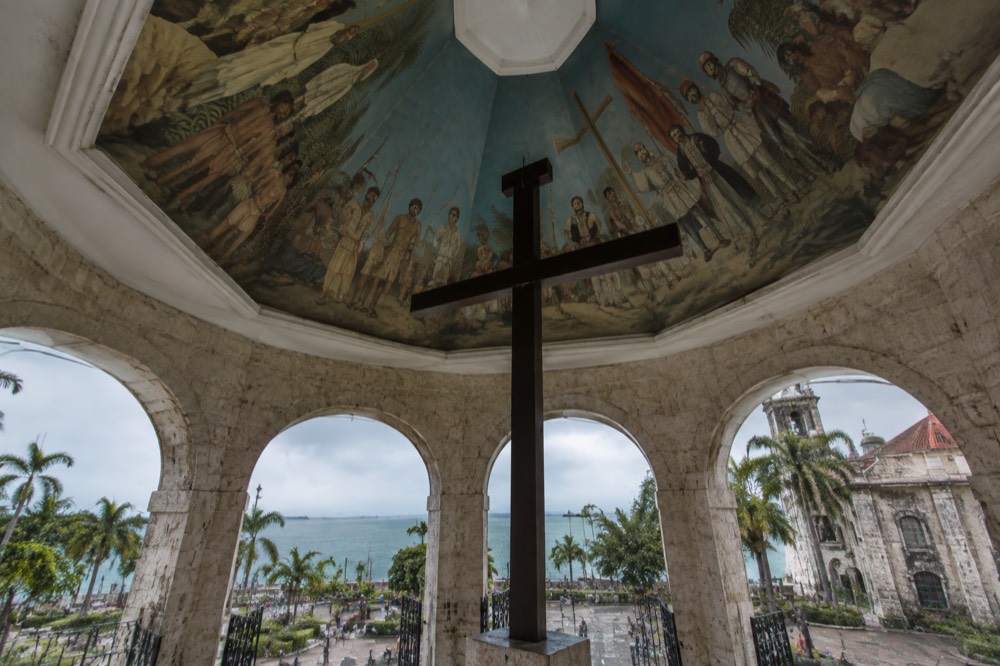
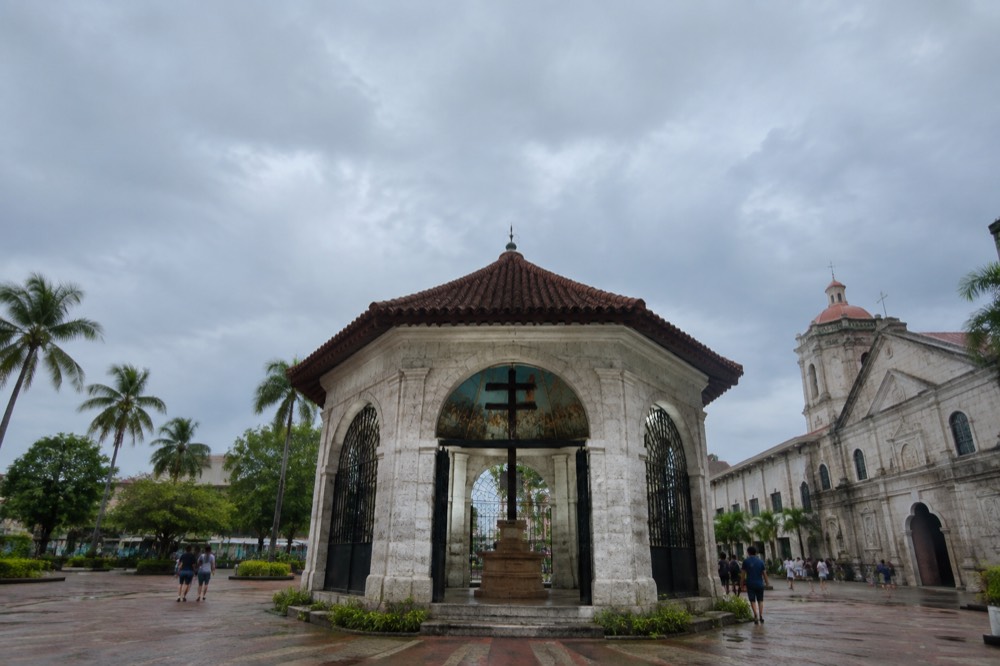
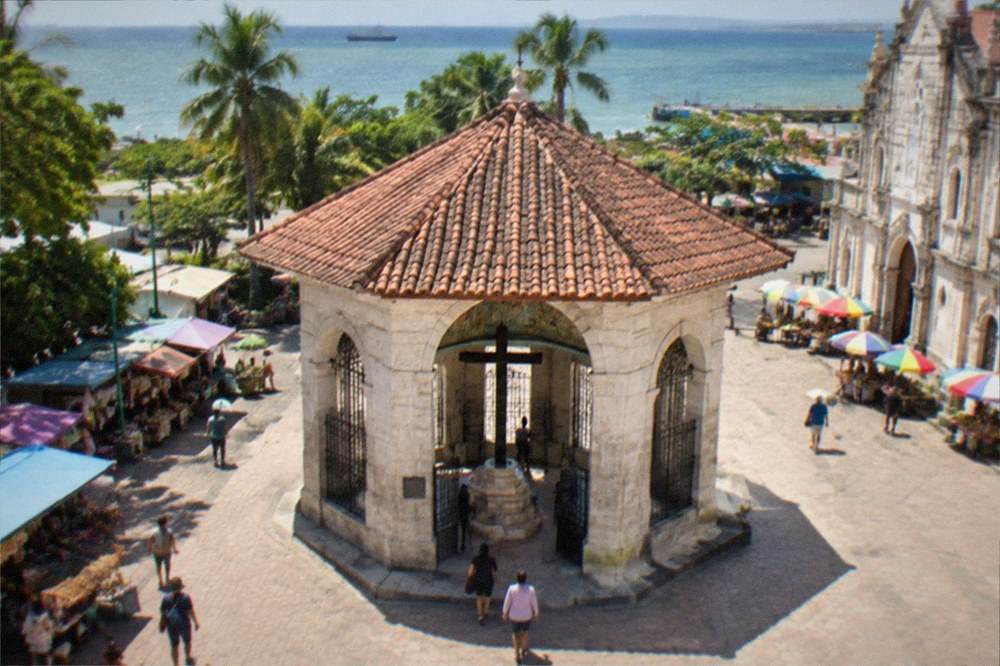
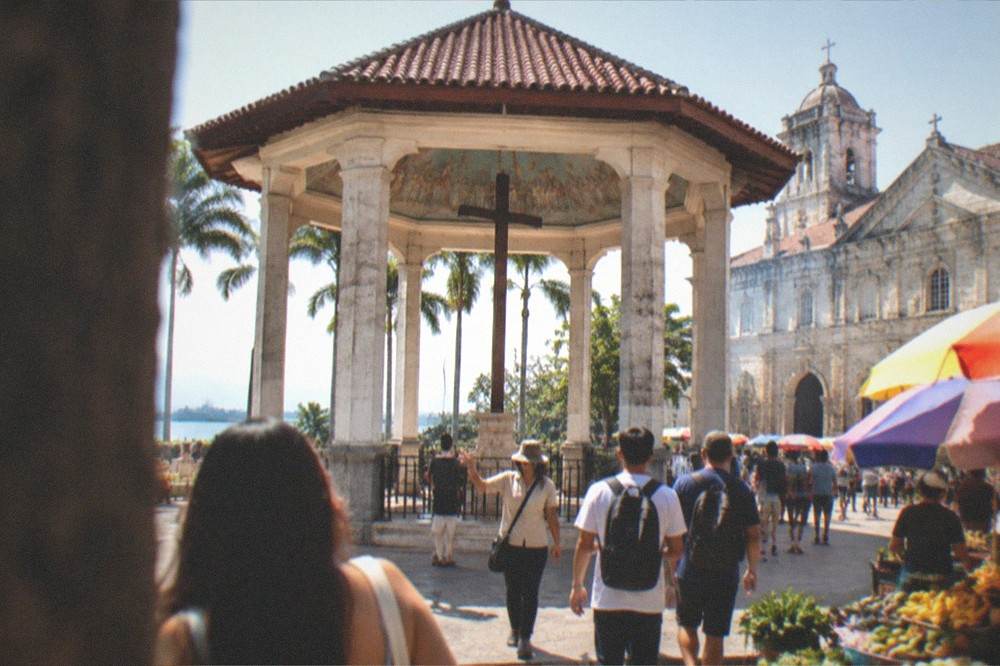
Magellan's Cross, housed in a domed pavilion on Magallanes Street, is the symbol of the 1521 arrival of Ferdinand Magellan's expedition and the introduction of Christianity to the islands. The Basilica's own history pages record that the cross tradition dates to April 1521 and that the current pavilion structure was built in 1834. It is free to enter, typically from about 8 AM to 6 PM, and the painted ceiling inside the dome is itself a frame within a frame. Arrive before 9 AM: tour groups fill the small pavilion by mid-morning and the painted ceiling disappears under a forest of selfie sticks.
The Basilica Minore del Santo Niño next door was founded on 28 April 1565 on the site where the Santo Niño image was found, and the present structure was built between 1735 and 1740. Its stone façade photographs best in early morning light, when the sun rakes across the coral stone. The belfry, damaged in the 2013 Bohol earthquake and later restored, is the classic telephoto detail from the plaza.
Fort San Pedro, the oldest triangular bastion fort in the country, dates its stone structure to 1738, with work first started under Legazpi in 1565. It opens at 8 AM and closes at 7 PM, and the low morning angle across its coral walls and lawns is the shot. The 2026 fee update confirmed P50 (about US$0.8) regular and P40 (about US$0.6) student and senior entry, unchanged from before.
Colon Street, often called the oldest street in the country, and the Heritage of Cebu Monument, a sculpted tableau of Cebu's history, round out a half-day heritage walk. For a deeper route through these sites, see the one-day Cebu City itinerary.
What Are The Best Street Photography Spots In Cebu?
The best street photography spots in Cebu are Carbon Market, Colon Street, the jeepney routes through downtown Cebu City, and the night food stalls around the Fuente Osmeña circle. Carbon, the island's biggest public market, delivers raw colour, crowd energy and food close-ups from before dawn, while Colon's neon shopfronts and the jeepney terminals give the grittier urban frames. A guided market walk is the easiest way in, since a guide handles introductions at stalls where a camera alone can feel intrusive.
Carbon Market is the island's commercial heart and its most productive street photography location. Produce arrives before dawn, and the first hours of light bring stacked fruit, ice blocks, woven baskets and a hundred unguarded faces. This is where a local guide earns their fee: the Cebu Market & Food Tour walks the market and backstreet food stops with someone who knows which vendors welcome a camera, and the operator keeps its price unpublished on the live listing, so check the live page for the current figure.
Jeepneys themselves are a subject. The decorated bodies, dashboard shrines and hand-painted signs are rolling folk art, and a ride through downtown costs the minimum jeepney fare. The walking tours of the city include a jeepney ride as part of the route, which is a low-friction way to shoot from inside one without negotiating alone.
Colon Street after dark is neon, signage and foot traffic, best worked with a fast prime. The Fuente Osmeña circle and the surrounding bars and barbecue stands keep the street busy late, and the area is covered in the Cebu nightlife guide.
Where Are The Best Waterfall And Nature Photography Spots In Cebu?
The best waterfall and nature photography spots in Cebu are Kawasan Falls in Badian, Tumalog Falls near Oslob, and the sardine run at Moalboal's Panagsama Beach, all three in south Cebu and linkable on a two-day south coast route. Kawasan's Level 1 entrance costs about P200 (about US$3.2) per person, Tumalog Falls charges about P50 (about US$0.8), and Moalboal's environmental user fee to swim or snorkel with the sardine school is P100 (about US$1.6).
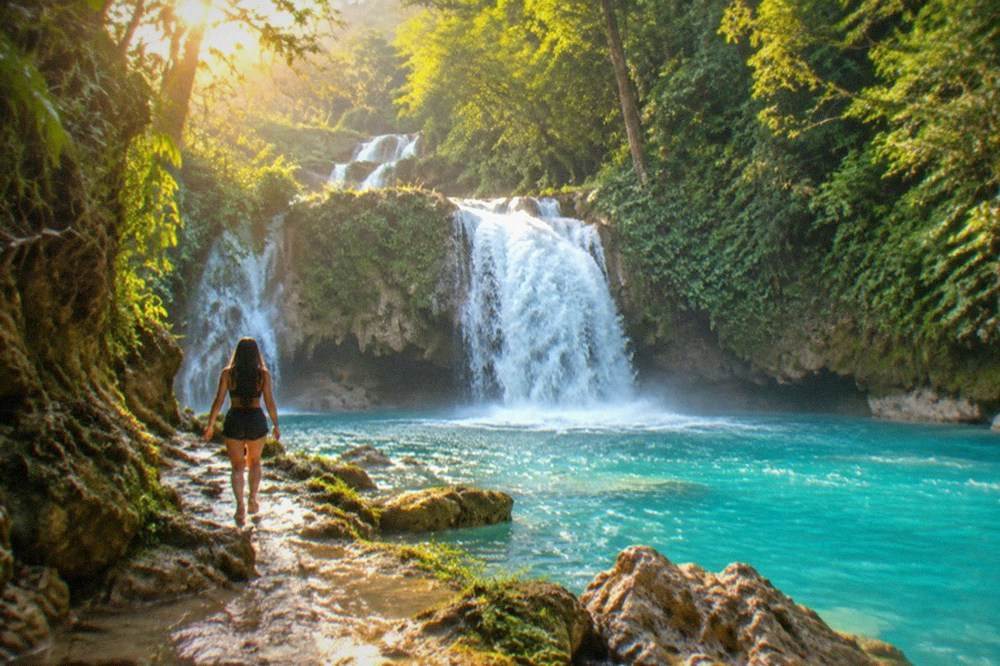
Kawasan Falls is the most photographed waterfall on the island, and the reason is the water: a striking turquoise against the jungle green. The Level 1 basin, the big postcard pool, is open to independent visitors for about P200 (about US$3.2), though cliff jumping is now banned there and a rope barrier manages swimmers. A phased 110-million-peso rehabilitation programme began in June 2026 and the site stayed open throughout, so expect some scaffolding in wider frames. The Kawasan Falls Day Tour from Cebu runs there from the city; the operator does not publish its price, so the listing is the place to check.
Tumalog Falls, a short habal-habal ride from the Oslob whale shark area, is a wide curtain of water over a mossy amphitheatre. It is best shot in morning light with the mist still rising, and the entrance fee is about P50 (about US$0.8). The ride from Tan-awan costs roughly P50 (about US$0.8) to P100 (about US$1.6) each way.
The Moalboal sardine run is the most extraordinary nature shot in the province: a permanent, resident school of sardines swirling a few metres from the shore at Panagsama Beach. The municipal tourism site confirms the school is accessible from the beach, and local guides report the best visibility from December to May. The environmental user fee to enter the water is P100 (about US$1.6) under the local ordinance. Shoot it snorkelling with a wide lens in the first two hours of morning light.
| Nature spot | Location | Entry or fee | Best shooting window |
|---|---|---|---|
| Kawasan Falls Level 1 | Badian | About P200 (about US$3.2) | Morning light before crowds |
| Tumalog Falls | Oslob | About P50 (about US$0.8) | Early morning mist |
| Moalboal sardine run | Panagsama Beach | P100 (about US$1.6) user fee | First two hours of light |
| Osmeña Peak | Dalaguete | About P50 (about US$0.8) to P100 (about US$1.6) registration | Sunrise above the clouds |
| Sirao Flower Garden | Busay | About P100 (about US$1.6) | Morning, before haze builds |
Osmeña Peak, the highest point on the island at Dalaguete, deserves its own early alarm. Its jagged ridge line is unlike anywhere else in Cebu, and sunrise shoots there often stand above the coastal haze. Registration is reported at roughly P50 (about US$0.8) to P100 (about US$1.6), with a local guide customary. The south Cebu itinerary links the peak with the falls and the coast.
Is Oslob Worth Photographing, And What Does It Cost?
Oslob is worth photographing if wildlife is your priority: whale shark encounters run from about 6 AM to 12 PM daily, cost P1,000 (about US$15.9) per foreign visitor and P500 (about US$8.0) per Filipino with boat and guide included, and put you in the water with the largest fish in the sea. Sightings are not guaranteed, and in late May 2026 the whale sharks were absent from the Tan-awan interaction area for about four days. The encounter itself runs about 30 minutes.
The fee detail matters for planning: the rates are P1,000 (about US$15.9) for foreign visitors and P500 (about US$8.0) for Filipinos under the 2020 municipal ordinance, which took effect again from 21 March 2025. The photography here is in-water work: a wide lens, no sunscreen (it is banned), a mandatory life jacket and a minimum four-metre distance from the animals. The rules are set by the Oslob municipal tourism office, and the feeding that keeps the sharks near the surface is done only by licensed spotters, a practice the town's mayor publicly defended as a minor lure in May 2026. The ethics of that feeding are genuinely debated, and anyone weighing it should read the discussion in the Oslob whale shark guide before booking.
The practical photographer's notes are these. Go on the earliest slot; the water is calmer and the light angle better before 8 AM. Shoot from the surface, not below, and let the animal fill the frame against the sun. And build a backup plan, because the sharks move with the plankton: Tumalog Falls and Sumilon Island are both within a short ride and both photograph well. The Oslob day trip guide covers the logistics.
What Are The Best Beach And Island Photography Spots In Cebu?
The best beach and island photography spots in Cebu are the Mactan island-hopping circuit of Gilutungan, Caohagan and Nalusuan, Sumilon Island off Oslob, and the wide sandbars of Bantayan Island. Island hopping from Mactan carries an environmental fee for foreign tourists, plus marine sanctuary fees at each island, and Sumilon's Bluewater day pass price varies depending on the day. All three are reachable as day trips from Cebu City or Mactan.
The Mactan route is the most accessible: a boat from Lapu-Lapu City reaches shallow sandbars and marine sanctuaries within an hour. The environmental fee for foreign tourists is P100 (about US$1.6), and marine sanctuary fees run roughly P150 (about US$2.4) to P300 (about US$4.8) per island. The operator's listing for the Mactan island hopping tour covers Gilutungan, Caohagan and Nalusuan in about six hours with lunch included. Shoot the sandbars on a mid-tide morning with a drone-height perspective from the boat's roof before anyone walks on them.
Sumilon Island, a short boat ride from Oslob, has a shifting white sandbar and a clear lagoon. The Bluewater resort's own offers page lists day use from 8 AM to 3 PM with boat transfers, and a group day rate of P2,000 (about US$32) net per guest Monday to Thursday, valid to 15 October 2026, consumable for food and drinks. It is the most controlled, most polished beach shoot in the south.
Bantayan Island, at the northern end of the province, is the wide-frame beach destination: long empty sand, fishing boats and low light. Getting there involves a Hagnaya terminal fee of P25 (about US$0.4) and a Santa Fe ecological fee of P30 (about US$0.5) on arrival. The island's tourism recovered through 2026 after the September 2025 earthquake, and the Department of Tourism confirmed Bantayan and Malapascua open by late October 2025. More options are in the Cebu beaches guide.
When Is The Best Time Of Year For Photography In Cebu?
The best time of year for photography in Cebu is the dry season from December to May, when PAGASA's national classification gives the lowest rainfall and the most dependable light, with March and April the driest months on the Mactan station record. The rainy season runs June to November, with typhoon risk peaking roughly July to October and Visayas landfall risk high in November and December. For festivals, the third Sunday of January brings the Sinulog Grand Parade.
The climate here is tropical with two seasons, not four. PAGASA's rule for the country is a rainy season from June to November and a dry season from December to May, and the Mactan station's 1991-2020 annual normals show 1,685.0 mm of rain over 138 rain days, with a mean temperature of 28.1 degrees. What that means in practice for a photographer: December to February gives the cleanest air for long-distance work from Tops Lookout, March to May gives harsher but very stable light for beaches and waterfalls, and June to November means carrying rain covers and working around afternoon downpours rather than cancelling shoots.
Typhoon Tino in November 2025 was a serious reminder of the season's reality: it brought severe flooding to Cebu and 253 deaths across the Philippines. The Department of Tourism moved quickly to confirm the core tourism zones of Cebu City and Mactan were largely unaffected and open, but anyone planning a November trip should read the typhoon season guide and the best time to visit guide first.
Sinulog, on the third Sunday of January, is the single most photogenic day of the Cebu year. The Grand Parade fills the streets with dancers, drums and colour, and the 2027 edition is set for 17 January 2027 with the Cebu City Sports Center as its main venue. It is crowded, hot and demanding: shoot with two bodies, one wide and one short telephoto, and read the Sinulog festival guide for the route and vantage points.
| Season | Months | Photography conditions |
|---|---|---|
| Cool dry | December to February | Cleanest air, best for city panoramas and festivals |
| Hot dry | March to May | Stable harsh light, best for beaches and waterfalls |
| Rainy | June to November | Afternoon downpours, lush greens, typhoon risk peaks July to October |
What Camera Gear Should You Bring For Shooting In Cebu?
The camera gear that matters most for shooting in Cebu is a weather-sealed body with two lenses, a wide zoom for the lookouts and waterfalls and a short telephoto for street and festival work, plus a dry bag, reef-safe practices and spare batteries for tropical humidity. Rain protection matters more than lens speed, since June to November brings sudden downpours, and no sunscreen is allowed in the Oslob whale shark area.
Cebu's conditions are tropical year-round, so the honest gear list is short and practical. Humidity is the silent killer: silica gel packs and a dry bag for boat days protect more equipment than any extra lens. For the lookouts, a wide zoom captures the panorama and a 70-200mm equivalent compresses the city lights at dusk. For Carbon Market and Colon Street, a single fast prime in the 23mm to 35mm range keeps you mobile and unobtrusive.
In the water, the choice is between a dome port for a big rig or a modern action camera for everything else. At Oslob the rules are fixed: no sunscreen, no flash, minimum distance of about four metres, life jacket mandatory. A neutral-density filter earns its place at Kawasan Falls for smoothing the water in daylight, and a polariser cuts glare on the boat at Sumilon and Pescador.
Power is the last practical detail. Outlets in the Philippines run 230 volts at 60 hertz with plug types A, B and C, so a universal adapter covers hotels across the island. Charge overnight and carry spares: a Sinulog parade day or an Oslob early start leaves no time to hunt for an outlet.
Which Spots Near Cebu City Can You Photograph In Half A Day?
The spots near Cebu City you can photograph in half a day are Tops Lookout, the Temple of Leah and Sirao Flower Garden on the Busay ridge, or the downtown heritage cluster of Magellan's Cross, the Basilica del Santo Niño and Fort San Pedro. The ridge route needs a car or habal-habal and a modest entry fee at each stop, while the heritage cluster is walkable and costs nothing beyond Fort San Pedro's small entry charge. Either route fits between breakfast and a late lunch.
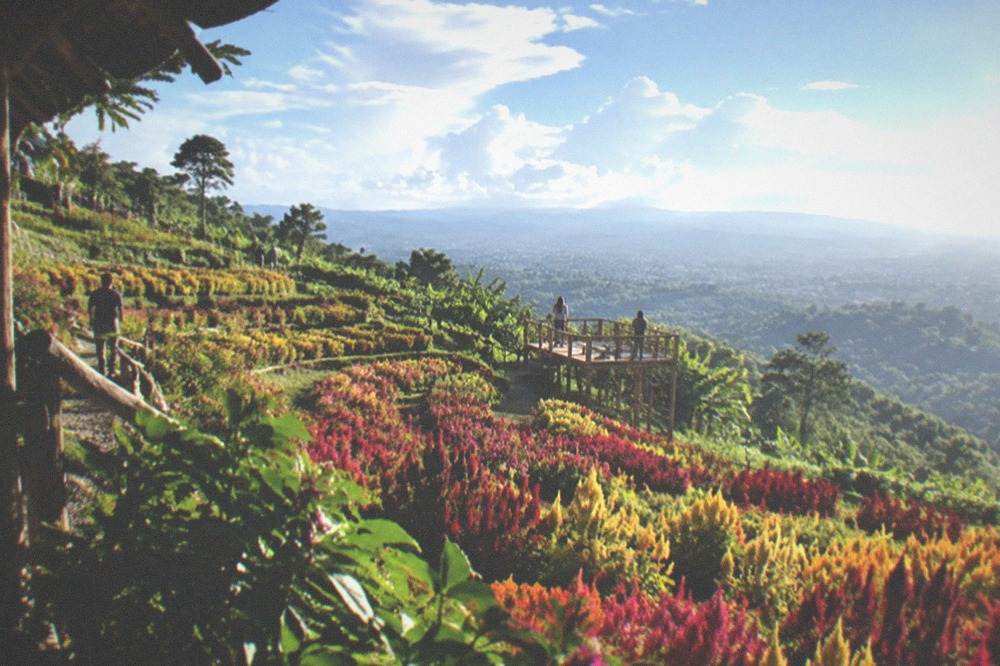
The Busay ridge route fits a half-day. Start at Sirao Flower Garden, where celosia blooms in terraced beds against a hillside backdrop, entry about P100 (about US$1.6). Move to the Temple of Leah for architecture and mountain light, then finish at Tops Lookout for the panorama, shooting the city as the afternoon haze burns off. The highlands tour product on the roster covers temples, gardens and views in a half-day format with a guide and transport, which removes the need to negotiate motorcycle rides on a mountain road.
The downtown route suits a morning. Magellan's Cross first, before the crowds, then the Basilica façade in raking light, then Fort San Pedro as the sun clears the walls, finishing on Colon Street as the shops open. It costs almost nothing, and every location is within a 15-minute walk of the others. The getting around Cebu guide covers the jeepney and taxi options between the two zones.
Are There Photography Rules Or Restrictions At Cebu's Attractions?
Yes, Cebu's photography restrictions are real but modest: Oslob bans sunscreen, flash and touching of whale sharks, Kawasan Falls bans cliff jumping at the main basin and restricts independent visitors to Level 1, the Olango Island Wildlife Sanctuary charges a professional camera fee, and religious sites including the Basilica expect modest dress and no flash during masses. Otherwise casual photography is welcome almost everywhere for personal use.
The wildlife rules are the strictest, and rightly so. At Oslob the four-metre distance, the licensed feeding and the 30-minute session are enforced by the municipal tourism office. At Moalboal, the sardine school is protected by sanctuary rules: no feeding, no anchoring at Pescador, mooring buoys only, and a guide accompaniment requirement in the sanctuary zones.
The Olango Island Wildlife Sanctuary, a Ramsar site since 1 July 1994 and the first in the Philippines, is the one place with a specific camera fee: a professional camera fee of P500 (about US$8.0) applies, with entrance at P100 (about US$1.6) for foreign visitors and P30 (about US$0.5) for Filipino adults. The bird season runs roughly September to March, with over 60 migratory species, and the Olango Island bird guide covers the hides and tides.
At churches, the working rule is respect. The Basilica holds masses through the day, and its pre-pandemic schedule was restored in November 2024, so check the mass times and shoot the façade and plaza rather than the interior during services. Museums including Casa Gorordo, entry about P100 (about US$1.6), generally allow non-flash photography but ask at the desk.
| Location | Photography rule | Fee impact |
|---|---|---|
| Oslob whale shark area | No sunscreen, no flash, no touching, 4 m distance | Included in P1,000 (about US$15.9) fee |
| Kawasan Falls | No cliff jumping at Level 1; independents limited to Level 1 | Included in about P200 (about US$3.2) entry |
| Olango Wildlife Sanctuary | Professional camera fee applies | P500 (about US$8.0) camera fee plus entry |
| Basilica del Santo Niño | No flash during masses, modest dress | Free |
| Moalboal sanctuaries | No feeding, no anchoring, guide in sanctuary zones | P100 (about US$1.6) user fee |
How Do You Plan A Multi-Day Photography Trip Around Cebu?
A multi-day photography trip around Cebu works best as a split between the city, the south coast and the north: two days based in Cebu City for heritage, markets and the Busay ridge, two days south for Oslob, Tumalog, Sumilon and Kawasan, and an optional two days north for Bantayan or Malapascua. The dry season from December to May is the window to aim for. Give the full loop a week.
The south is the classic first route. Day one: an early bus or private van to Oslob for the morning whale shark slot, Tumalog Falls before the midday heat, and Sumilon's sandbar in the afternoon, overnighting in Oslob or moving on to Moalboal. Day two: the sardine run at first light, then Kawasan Falls in Badian for the turquoise pools, returning to the city in the evening. The south is served by Ceres buses from the South Bus Terminal, with Oslob about four hours and Moalboal about three hours from the city. The south Cebu itinerary and the five days in Cebu guide lay out the timings.
The north is slower and wilder. Bantayan needs a half-day of travel each way, so it earns two nights, and Malapascua is the base for the thresher shark dives at Kimud Shoal, which run at dawn. The Malapascua thresher shark guide covers the dive logistics; the sharks are mostly seen at Kimud Shoal now, with Monad Shoal secondary.
Budget roughly a week for the full loop. The Cebu budget and costs guide has the numbers, and the seven days in Cebu guide is the ready-made frame for it.
Common Questions About Photography Spots In Cebu
Where is the best sunset spot in Cebu?
Tops Lookout in Busay is the best sunset spot in Cebu, open 24 hours with P100 (about US$1.6) regular entry, looking down over Cebu City and the Mactan Channel. The Temple of Leah terrace nearby and the Nustar Skydeck on the waterfront are strong alternatives, the latter best after dark.
Do you need a permit to photograph in Cebu?
No permit is needed for casual personal photography at Cebu's public attractions. The specific exceptions are the professional camera fee of P500 (about US$8.0) at the Olango Island Wildlife Sanctuary and the standard entry fees at each site, such as P100 (about US$1.6) at Tops Lookout and P50 (about US$0.8) at Fort San Pedro. Commercial shoots at private venues such as resorts are arranged directly with the venue.
Is Cebu good for photography?
Yes. Cebu combines heritage sites dating to 1521 and 1565, mountain lookouts, turquoise waterfalls, a resident sardine school a few metres from shore, whale shark encounters and dense street markets, all on one island. The dry season from December to May gives reliable light, and Sinulog in January is one of the most photogenic festivals in the Philippines.
What is the most photographed place in Cebu?
Magellan's Cross and the Basilica del Santo Niño in downtown Cebu City are the most photographed places in the province, both free to view and within a short walk of each other. Kawasan Falls is the most photographed natural site, and Tops Lookout is the most photographed panorama.
Can you use a drone in Cebu?
Drone use in the Philippines is regulated, and flying near crowds, airports and urban areas requires care with the national rules. Mactan-Cebu International Airport sits close to Lapu-Lapu City, so much of the Mactan area is sensitive airspace. Check current national aviation rules before travelling, and never fly over the Sinulog parade crowds.
What lens is best for whale shark photography in Oslob?
A wide lens in the 16mm to 24mm range, in a housing or on an action camera, is best for whale shark photography in Oslob, because the animals pass close to the surface and fill a wide frame quickly. Flash is banned, no sunscreen is allowed, and a minimum distance of about four metres is enforced, so shoot with available light from the surface.
Which Tour Helps You Photograph Cebu With A Local's Eye?
The tour that best helps you photograph Cebu with a local's eye is a guided market and food walk in Cebu City, because markets are where a guide's introductions matter most and where the island's most authentic frames live. The Cebu Market & Food Tour runs three to four hours through the stalls and backstreets. For waterfalls and islands, the Kawasan Falls and island hopping day tours cover the south and the Mactan circuit respectively.
A guide changes the equation at Carbon Market more than anywhere else. Vendors who stiffen at an unknown camera relax when a familiar face makes the introduction, and a food walk builds the shoot around stops that earn their photograph: the lechon stall, the fruit stackers, the ice merchants. The Cebu lechon guide explains why that dish alone draws photographers to the city. The market walk's operator keeps its price unpublished on the live listing, so the live page is the source for the current figure.
The same logic applies on the coast. The Kawasan Falls day tour times the falls before the midday crowds, and the island hopping day tour from Cebu reaches the sandbars and sanctuaries with a crew who know the tide windows. Neither operator publishes its price, so both render through the listing rather than a printed figure.
The honest summary is that Cebu rewards photographers who plan around the light and the fees rather than turning up cold. Tops Lookout at dusk, Carbon at dawn, Kawasan before the crowds, Oslob at the first slot: those four decisions cost almost nothing and shape the whole take. Pack rain protection whatever the month, check the live listings for the tour prices, and give the island at least five days if the north is on the list.