Cebu Honeymoon Itinerary
Cebu, an island province in the Central Visayas region of the Philippines, compresses reef, mountains, heritage and resort comfort into one honeymoon week. This itinerary balances slow resort mornings with two big adventure days, a food crawl through Cebu City, and an evening show, so the trip never feels like a checklist.
Short answer
Base yourselves on Mactan for beach comfort, spend two days in the south for whale sharks and canyoneering, one day in the Cebu City highlands, and keep at least two unscheduled resort days. December to May is the dry season, and the whole week can be planned around a handful of fixed local fees.
Cebu, an island province in the Central Visayas region of the Philippines, is one of the few honeymoon destinations where a coral reef, a 1,000-metre mountain ridge, a basilica founded in 1565 and a five-star beach resort all sit within a two-hour drive of each other. A couple can snorkel with sardines in the morning, eat lechon at a market stall at noon, and watch the sun drop into the Tañon Strait from a hilltop in the evening. This itinerary is built for that range. It assumes seven days, two of them deliberately left soft, because a honeymoon that is fully scheduled is just a business trip with better weather.
Why Cebu Works For A Honeymoon
Cebu works for a honeymoon because it packs beach, mountain, heritage and marine life into a single week without a single domestic flight, and because the local fee structure is transparent enough that the biggest costs are the ones you control, the hotel and the flights. The province runs on one international airport, Mactan-Cebu, with fastcraft ferries and coastal highways connecting everything else. Whale sharks, waterfalls and a year-round sardine run are all day trips from a resort base. This site, Cebu Travel Guide, exists because the province rewards exactly this kind of planned variety.
The honest framing matters here. Cebu is not a single resort island like Boracay. It is a working province of about 3.3 million people outside its three independent cities, and parts of the south are a three-hour bus ride from the capital. That scale is the advantage: the crowds thin the further down the coast you go, and the itinerary below uses that gradient deliberately, keeping the busy first days near the city and saving the quietest water for the end.
Couples who want a shorter version of this trip can compress it. The 3 days in Cebu plan covers the city, the highlands and one south-coast day, and the 5 days in Cebu plan adds Moalboal. This guide is the full-length version, written for people who want the honeymoon week rather than a sampler.
When To Go, And What The Weather Actually Does
The best months for a Cebu honeymoon are December to May, PAGASA's dry season, with March and April the driest of all, and the rainy season from June to November bringing both the heaviest rain and the typhoon risk that can pause canyoneering and boat trips. The Mactan station's 1991-2020 normals put annual rainfall at 1,685.0 mm spread over 138 rain days, with October the wettest month in the monthly series at 194.8 mm and April the driest at 48.1 mm. Temperatures barely move: the annual mean is 28.1 C, with a mean maximum of 31.3 C and a mean minimum of 24.9 C, so pack for heat, not for seasons.
Two calendar facts shape the choice more than the rain chart. Sinulog, the province's grand festival, falls on the third Sunday of January, with the 2027 Grand Parade set for 17 January 2027 at the Cebu City Sports Center. Hotels fill and prices climb around it, so book far ahead if you want it, and book away from it if you do not. The second fact is typhoon season: the June-to-November window carries the peak cyclone risk roughly July to October, and November 2025's Typhoon Tino brought severe flooding to Cebu, though the Department of Tourism confirmed the core tourist zones of Cebu City and Mactan stayed open.
| Month band | What to expect in Cebu | Honeymoon verdict |
|---|---|---|
| December to February | Dry season, coolest stretch, Sinulog in mid-January | Best overall, book early for Sinulog week |
| March to May | Dry season, hottest stretch, April driest at 48.1 mm | Best for water activities, strongest sun |
| June to August | Rainy season begins, peak typhoon months approach | Cheaper rooms, accept rain risk |
| September to November | Wettest stretch, October 194.8 mm, high landfall risk | Avoid if the trip is non-refundable |
For couples who want the water at its clearest, the dive and snorkel reports consistently point to the December-to-May window, and the sardine run at Moalboal is year-round, so the calendar mainly decides rain, not wildlife.
Where To Stay: Mactan Resorts Or Cebu City
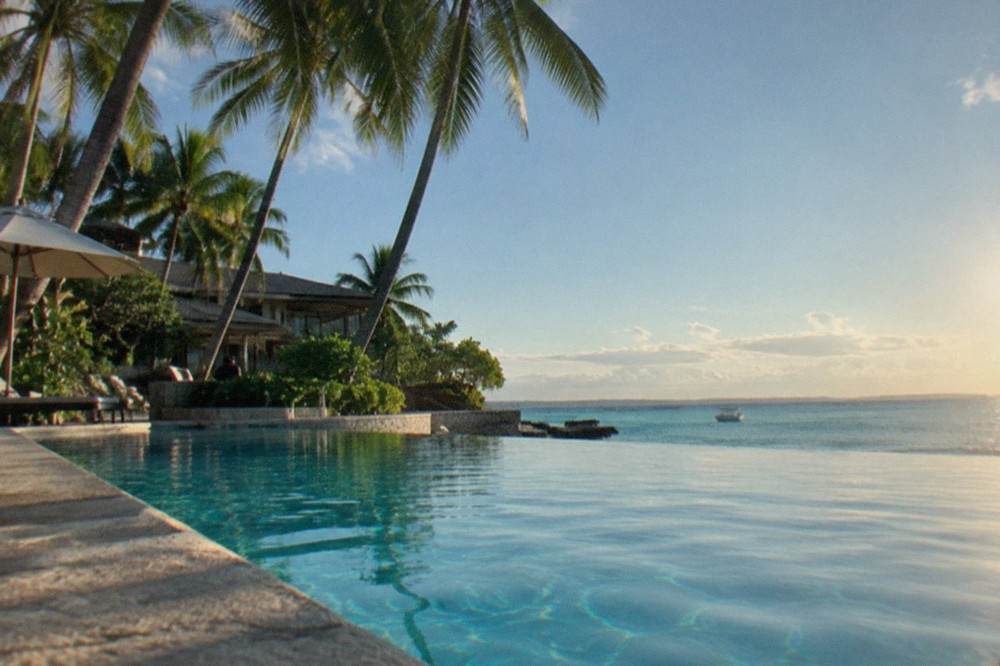
For a honeymoon, stay on Mactan Island, where the beach resorts sit directly on the Mactan Channel and the airport is minutes away, and use Cebu City only for the first or last night near the heritage sites, because the city has the food and the history but no swimmable beach of its own. Mactan's resort strip in Lapu-Lapu City carries the island's beachfront inventory, and the island's environmental fee for island hopping is P100 (about US$1.6) for foreign tourists. Cebu City, by contrast, is the heritage, food and nightlife engine, so a city-only honeymoon forfeits the water entirely.
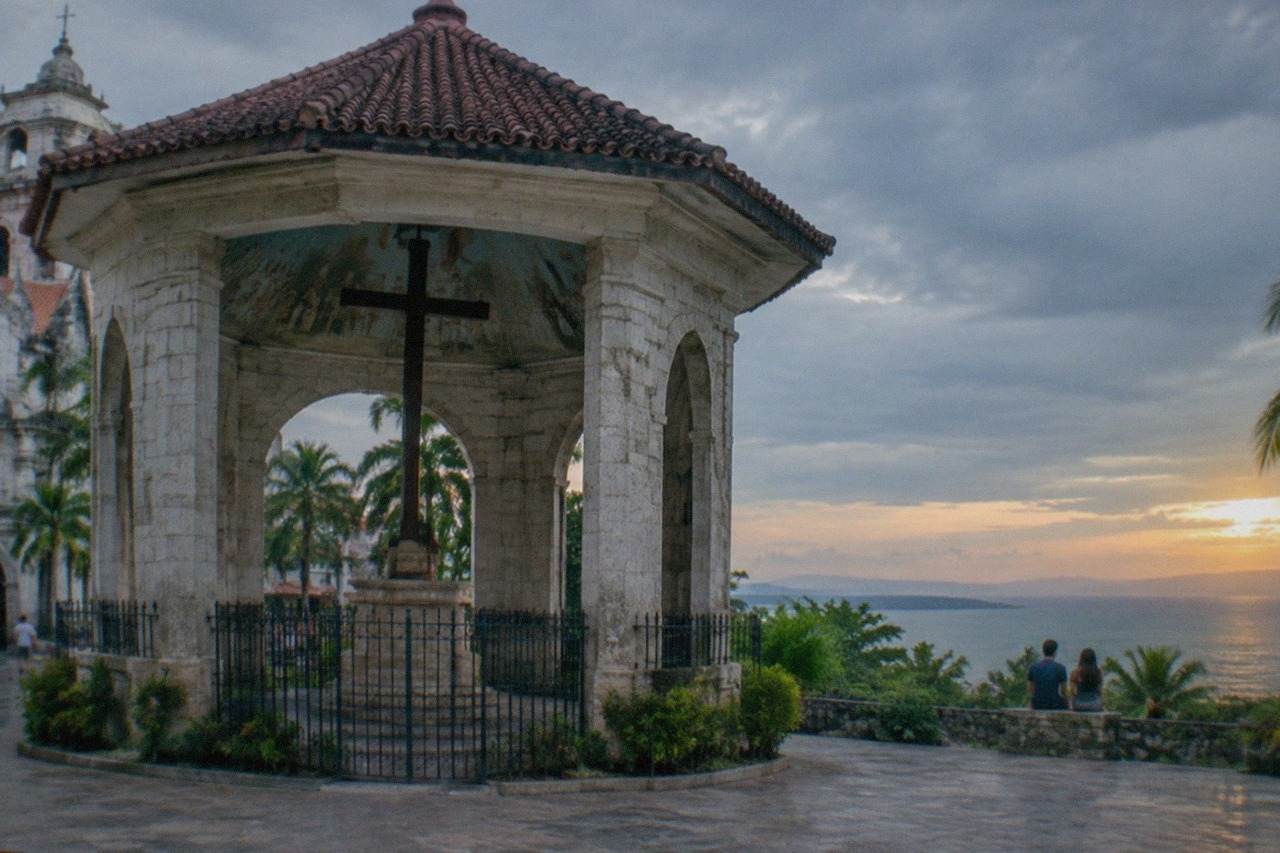
The split-stay approach works well in practice. Two nights in Cebu City put you beside the Basilica del Santo Niño and Magellan's Cross, walking distance from the markets the food tour uses, and then the move to Mactan starts the resort half of the week. The drive between them crosses the Marcelo Fernan or Osmeña bridge over the Mactan Channel, and the airport sits on the Mactan side, so the final morning's departure is short.
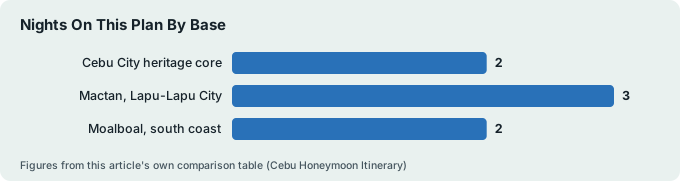
| Base | Best for | Trade-off | Nights on this plan |
|---|---|---|---|
| Cebu City heritage core | Basilica, food tour, nightlife, Tops Lookout access | No beach, traffic | 2 |
| Mactan, Lapu-Lapu City | Beach resorts, island hopping, airport proximity | Resort prices, distance to south coast | 3 |
| Moalboal, south coast | Sardine run, Kawasan Falls, quiet mornings | 2.5 to 3.5 hours from the city | 2 |
The three-night Moalboal stay is the itinerary's quiet half, and it is the part most couples end up ranking first. The Moalboal sardine run sits a few metres off Panagsama Beach, and the municipal site notes the early morning, around 7 to 9 AM, as the best window.
The Day-By-Day Seven-Day Cebu Honeymoon Itinerary
The itinerary runs two city nights, three Mactan resort nights and two Moalboal nights, with Day 1 for heritage and dinner, Day 2 for the food tour and the highlands, Day 3 for island hopping, Day 4 for whale sharks and Sumilon, Day 5 for canyoneering, and Days 6 and 7 for slow water and departure. Every activity day is a real, bookable product or a fixed local fee, and the two soft days are deliberate buffer against weather. The sequence front-loads the city while jet lag makes early mornings easy, then moves south as the trip relaxes.
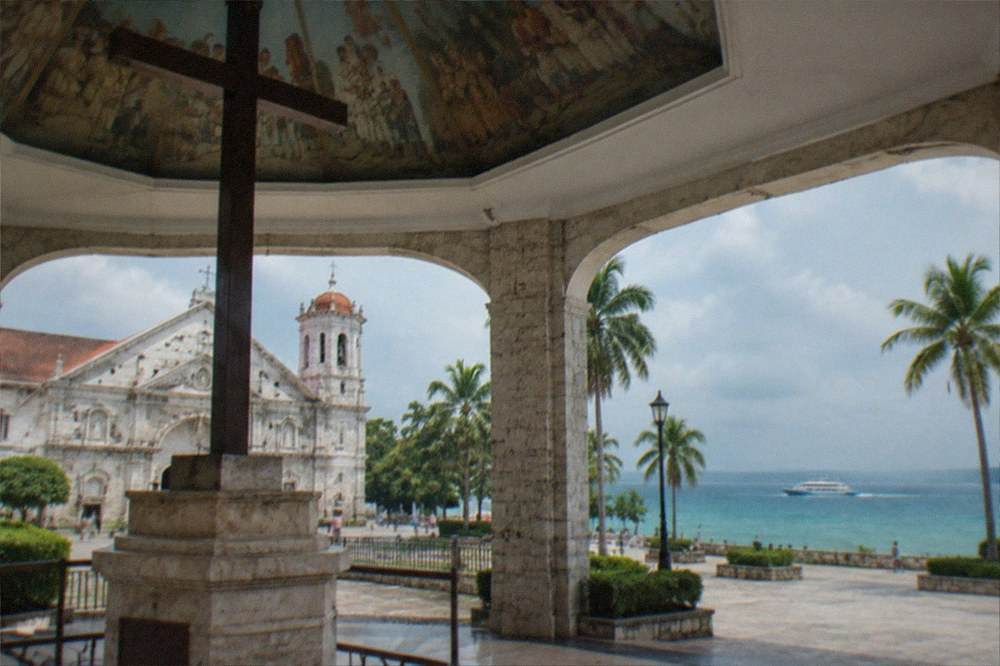
Day 1, Cebu City. Land at Mactan-Cebu International, where the MyBus runs to SM City Cebu for a fare of P50 (about US$0.8) and the yellow airport taxis flag down at P70 (about US$1.1). Check in near the heritage core. Spend the late afternoon at the Basilica del Santo Niño, whose current structure dates from 1735 to 1740, then walk to Magellan's Cross, which is free to visit and generally open about 8 AM to 6 PM. Dinner in the city, early night.
Day 2, food and the highlands. Morning is the Cebu market food tour, a three-to-four-hour walk through the markets, which the operator has not published a price for, so check the live listing. The afternoon goes up the Busay ridge: the Temple of Leah charges about P120 (about US$1.9) on weekdays and P150 (about US$2.4) on weekends, and Tops Lookout is open 24 hours with entry at P100 (about US$1.6), which makes it the sunset-and-moonlight stop. Stay for dark; the city lights below are the point.
Day 3, move to Mactan and island hop. Cross to Mactan and check into the resort, then spend the afternoon on the water. The Mactan island-hopping routes run to Gilutungan, Caohagan and Nalusuan, with sanctuary fees in the roughly P150 (about US$2.4) to P300 (about US$4.8) range per island and the Lapu-Lapu environmental fee of P100 (about US$1.6) for foreign tourists. The evening is free; the resort restaurants on this stretch are the honeymoon standard.
Day 4, whale sharks and Sumilon. The one genuinely early morning of the week. The Oslob whale sharks interaction runs from about 6 AM to noon, and the municipal fee is P1,000 (about US$15.9) per foreign visitor and P500 (about US$8.0) per Filipino, boat and guide included, with a minimum four-metre distance rule, no sunscreen and no touching. Sightings are the norm but not guaranteed: in late May 2026 the sharks were absent from Tan-awan for about four days when the plankton moved. Pair the morning with Tumalog Falls, entry about P50 (about US$0.8), and, if the budget allows, the Sumilon Island day pass, where the Bluewater resort's weekday group offer runs at P2,000 (about US$32) net per guest.
Day 5, canyoneering at Kawasan. The Badian route is the only one currently operating, as the Alegria route is suspended, and cliff jumping is banned at the main Level 1 basin. Guided canyoneering runs roughly P1,500 (about US$24) to P2,000 (about US$32) with a Badian-accredited guide including gear and lunch, while the Kawasan Falls Level 1 entrance alone is about P200 (about US$3.2) for couples who only want to swim. A P110 (about US$1.8) million rehabilitation programme has been running since June 2026 and the site has stayed open throughout.
Day 6, Moalboal slow day. Move down the coast, two and a half to three and a half hours by bus from the Cebu South Bus Terminal. The sardine run is offshore at Panagsama and the environmental user fee to swim or snorkel is P100 (about US$1.6). This is the do-nothing day: snorkel in the morning, nap, long dinner.
Day 7, departure. A final swim, then the bus or a private transfer back north. Flights out of Mactan-Cebu International, where the terminal fee is already bundled into the ticket and foreign tourists staying under a year are exempt from the Philippine travel tax.
| Day | Base | Anchor activity | Fixed local cost (per person) |
|---|---|---|---|
| 1 | Cebu City | Basilica and Magellan's Cross | Magellan's Cross free, Fort San Pedro P50 (about US$0.8) |
| 2 | Cebu City | Market food tour, then Temple of Leah and Tops | P120 (about US$1.9) weekday, P150 (about US$2.4) weekend, P100 (about US$1.6) Tops |
| 3 | Mactan | Island hopping, Gilutungan, Caohagan, Nalusuan | P100 (about US$1.6) environmental fee plus sanctuary fees |
| 4 | Mactan or Oslob day trip | Whale sharks, Tumalog Falls, Sumilon | P1,000 (about US$15.9) foreign whale shark fee, P50 (about US$0.8) falls |
| 5 | Badian day trip | Kawasan canyoneering or Level 1 swim | P200 (about US$3.2) entrance, P1,500 (about US$24) to P2,000 (about US$32) guided |
| 6 | Moalboal | Sardine run snorkel | P100 (about US$1.6) environmental user fee |
| 7 | Moalboal to airport | Transfer and departure | Terminal fee in ticket, no travel tax |
What A Cebu Honeymoon Week Costs
The fixed, non-hotel costs of this itinerary are modest: the attraction and environmental fees across all seven days add up to a small per-person total before tours, meals and accommodation, which means the hotel choice ends up dominating the whole week's budget almost entirely. Those attraction and environmental fees across all seven days total roughly P3,000 (about US$48) per person. Every peso figure below is a published local fee, not a tour price, and the bookable products on the plan render their own prices from their listings. The two big discretionary lines are the resort nights on Mactan and the private transfers, and both scale with taste rather than necessity.
Couples can run this week cheaply. Buses from the Cebu South Bus Terminal to Moalboal run every 30 to 45 minutes, the jeepney minimum fare is P14 (about US$0.2) for the first four kilometres on traditional units, and the food tour, the show ticket and the theme-park combo are the only products you need to book ahead at all.
| Cost line | Amount | Notes |
|---|---|---|
| Whale shark interaction, Oslob | P1,000 (about US$15.9) foreign, P500 (about US$8.0) local | Boat and guide included, about 30 minutes in the water |
| Kawasan canyoneering, guided | P1,500 (about US$24) to P2,000 (about US$32) | Badian route only, gear and lunch included |
| Kawasan Level 1 entrance, swim only | P200 (about US$3.2) | No guide needed for the main basin |
| Tops Lookout entry | P100 (about US$1.6) | Open 24 hours, P70 (about US$1.1) senior rate |
| Temple of Leah entry | P120 (about US$1.9) weekday, P150 (about US$2.4) weekend | Hours shortened since April 2026, confirm before going |
| Moalboal environmental user fee | P100 (about US$1.6) | Covers swimming and snorkelling at Panagsama |
| Sumilon day pass, weekday offer | P2,000 (about US$32) | Bluewater group offer, consumable on weekdays |
The pattern to notice is that the fees are per-person and cash-based, so carry small bills for the environmental-fee kiosks. The 7 days in Cebu plan breaks the daily spending down further for couples watching the total.
Romantic Meals And The Cebu Food Tour
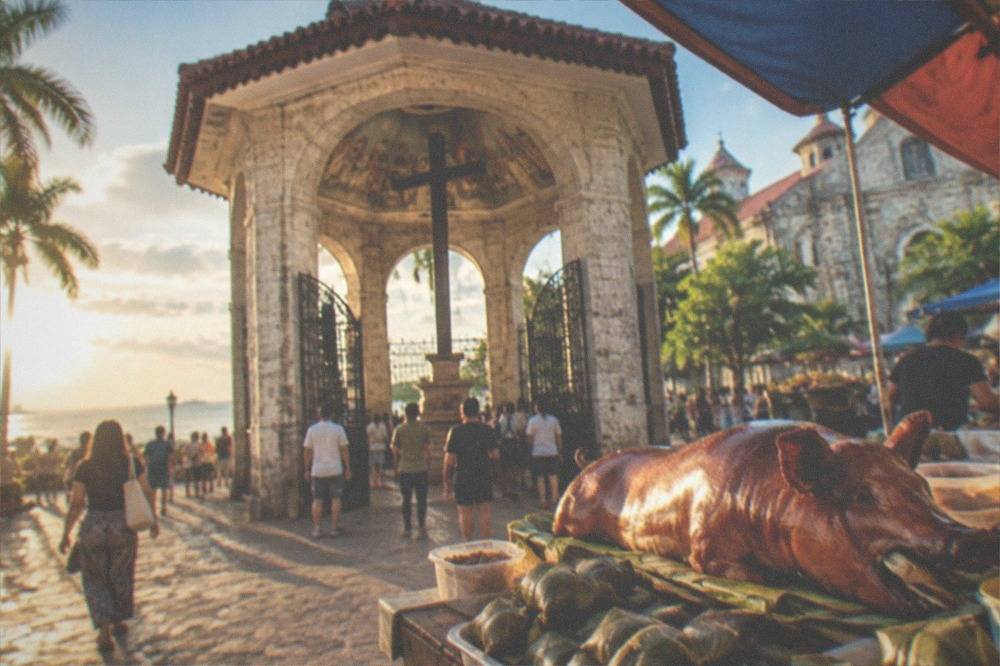
The food half of a Cebu honeymoon is genuinely distinctive, because the province's most famous dish, lechon, is a market and carinderia food rather than a restaurant invention, and the market food tour walks you straight through the stalls where it is made and eaten, with a guide who knows which pig came out of which oven that morning. The tour runs three to four hours, its price is not published by the operator so check the live listing, and it is the one fixed-time commitment on this plan. Beyond it, the evenings are flexible: Cebu City's restaurant scene runs from grill houses to rooftop dining, and the lechon stalls are a lunch culture, not a dinner one.
Two food rules make the week better. First, eat lechon at lunch, when the skin is still crisp, and pair it with the local puso, rice cooked in woven coconut leaves. Second, keep one dinner for the Mactan resort strip and one for a Moalboal beach bar, because the south coast's barefoot dinners are the more romantic of the two and cost a fraction of the resort version. Check availability once your dates are fixed, since the walk runs on a schedule.
Evenings Out: The Show And The Nightlife Question
Cebu's evening options for couples run from a staged production show to rooftop bars and casino-floor dining, and the show ticket is the one worth booking ahead because it anchors a whole night out in the city and turns an ordinary dinner evening into something that feels like an occasion rather than a routine. The Cebu Amazing Show is an evening production whose price is not published by the operator, so the live listing is the source. Beyond it, the city's nightlife clusters in the IT Park and Business Park areas, where the bars stay open late, and the Nustar complex added a glass-walled Skydeck attraction in February 2026 for couples who want a view with the drinks.
The honest note is that Cebu is not a party destination in the Boracay sense. The evenings here are long dinners, live music and a couple of bars, which suits a honeymoon better than a beach-club scene anyway.
Adventure Days For Active Couples
The two adventure days, whale sharks and canyoneering, are the physical core of the week, and both are regulated by local ordinances that cap group conduct and require accredited guides, which is why they should be booked rather than improvised on arrival with whoever is waiting at the gate. Oslob's interaction rules are municipal: a mandatory briefing, a minimum distance, no sunscreen, no flash, life jackets, and feeding only by licensed spotters. Badian's canyoneering ordinance covers guide conduct and gear, and the Alegria route remains suspended, so any operator selling Alegria is selling a route that is not running.
For couples who want a softer adventure day, the theme-park and ocean-park combination is the family-friendly option, pairing rides with a marine aquarium in a single product. Its price is not published by the operator, so check the listing. The Osmeña Peak hike is the other soft option, the highest point on the island at a modest registration fee of roughly P50 (about US$0.8) to P100 (about US$1.6), and it pairs naturally with a Kawasan day because both sit in the south.
Practical Tips For A Smooth Cebu Honeymoon
Four practical things decide whether this week runs smoothly: the eTravel registration within 72 hours before arrival, cash for every environmental fee kiosk, private transfers for the south-coast days, and a weather buffer built into Days 6 and 7 so one washed-out morning does not sink the whole plan. Visa-free nationals, including US, UK, EU and Australian citizens, get a 30-day initial stay, and eTravel registration is free at the official government site, a point worth repeating because fake eTravel sites charging fees are a recurring scam. Foreign tourists staying under a year are exempt from the Philippine travel tax, so do not budget for it.
Transport is the one thing worth spending on. The Ceres buses south are cheap and frequent, but the whale-shark morning starts before 5 AM from the city, and a private transfer turns a 3.5-hour bus ride into a two-and-a-half-hour car ride you can sleep through. Grab operates across Cebu City, Mandaue and Lapu-Lapu with upfront pricing in the app, which removes the meter anxiety entirely.
| Practical item | What to do | Why it matters |
|---|---|---|
| eTravel | Register within 72 hours of arrival, free | Mandatory, fake sites charge fees |
| Cash | Small bills for every environmental fee kiosk | Fees are P50 (about US$0.8) to P1,000 (about US$15.9), cash-based |
| South transfers | Private car for Days 4 and 5 | Whale shark briefing starts early |
| Weather buffer | Days 6 and 7 kept soft | Rain closures pause canyoneering, not resorts |
| Visa | 30 days visa-free for US, UK, EU, Australia | Extendable at the Bureau of Immigration |
One last note on timing the whole plan: the best-time question and the honeymoon question have the same answer, December to May, and the earlier in that window you travel, the lower the typhoon-season carryover risk. A honeymoon in March sees the driest air, the clearest water and the thinnest crowds of the whole year.
How To Shorten Or Extend This Cebu Honeymoon
Cut the Moalboal nights for a five-day version, cut the Kawasan day too for a four-day version, and extend with Bohol or Bantayan if you have nine days or more, because both add genuinely different water rather than more of the same coastline. The five-day compression keeps the city nights, the Mactan resort and the whale-shark day, which is the shape of the 5 days in Cebu plan. The 7 days in Cebu plan is the full framework this page is built from, and the 3 days in Cebu plan is the short version that still catches Tops Lookout and one south-coast highlight.
The extensions are worth the ferry. Bohol sits about two hours from Cebu City by OceanJet fastcraft from Pier 1, with tourist-class fares at P960 (about US$15.3) and business class at P1,440 (about US$23) since the September 2026 fuel surcharge, and the Bohol day trip itinerary covers the Loboc River cruise and the Chocolate Hills in a single long day. Bantayan Island, north-west across the Tañon Strait, is the quiet-beach extension, with a P25 (about US$0.4) terminal fee at Hagnaya and a P30 (about US$0.5) ecological fee on arrival at Santa Fe.
Common Questions About Cebu Honeymoons
Is Cebu a good honeymoon destination?
Yes, for couples who want variety rather than a single beach. Cebu combines beach resorts on Mactan, whale shark and sardine-run snorkelling, waterfall canyoneering, heritage sites dating to 1521 and 1565, and a strong food scene, all within a province served by one international airport and no domestic flights. The dry season, December to May, makes the water clearest and the plans most reliable.
How many days do you need for a Cebu honeymoon?
Seven days is the comfortable answer: two nights in Cebu City, three on Mactan and two in Moalboal. Five days works if you drop Moalboal, and three days covers the city, the highlands and one south-coast highlight. Anything shorter forces a choice between the heritage north and the water south.
What is the best month for a Cebu honeymoon?
March or April. Both sit in PAGASA's dry season, April is the driest month in the Mactan station's normals at 48.1 mm of rain, and both avoid the Sinulog crowd spike in mid-January. December to February is cooler; June to November is the rainy season with peak typhoon risk roughly July to October.
Is Cebu expensive for a honeymoon?
The local fees are low: the whale shark interaction is P1,000 (about US$15.9) per foreign visitor, Kawasan canyoneering runs P1,500 (about US$24) to P2,000 (about US$32) guided, and most entrance fees are P100 (about US$1.6) or less. The budget is dominated by the Mactan resort rate and flights, so the same week can be run lean or luxuriously depending on the hotel.
Do foreign tourists pay the Philippine travel tax when leaving Cebu?
No. The travel tax, P1,620 (about US$26) economy and P2,700 (about US$43) first class, falls on Filipinos and resident taxpayers. Non-immigrant foreign tourists whose stay is under one year are exempt, so it does not belong in a honeymoon budget. The airport terminal fee is already bundled into the airline ticket.
Which is better for couples, Mactan or Cebu City?
Mactan for the honeymoon itself, because the beach resorts are there and the airport is minutes away. Cebu City for the first or last night, because the Basilica, Magellan's Cross, the food tour and Tops Lookout are all city-side. The split-stay plan in this itinerary uses both deliberately.
The week, at its core, is a rhythm: two days of city and food, three of resort and reef, two of quiet south-coast water. Plan the fixed bookings, the food tour, the show and the adventure days, leave the rest soft, and let the evenings do what honeymoon evenings are for.